
...

Featured Post
Why Employers Need Independent Claims Oversight
Featured Post
Why Employers Need Independent Claims Oversight



Most Self-Funded Plans Review Less Than 5% of Claims. Here's the Problem

Abhishek Ghosh

May 29, 2026
A regional manufacturer with 1,400 employees ran an independent claims audit in 2024 and found $812,000 in overpayments across 18 months. The errors included a $47,000 inpatient claim paid twice, 63 ineligible dependents still on the plan, and a specialty drug billed at 240% of the contracted rate.
None of these issues had been identified during the TPA's internal reviews, leading the plan sponsor to realize that many routine claims audits examine only a small portion of total payments.
The 5% Problem: What Self-Funded Plans Actually Review
The gap is straightforward. Most self-funded employers think their claims are audited, but only a small slice is actually examined. A standard TPA audit usually reviews a stratified sample of 250 to 400 claims against plan documents and then reports an overall accuracy rate.
For a plan handling 80,000 claims annually, that works out to roughly 0.3% to 0.5% of total claims activity.
Even when internal TPA quality checks are included, scrutiny rarely reaches 5% of total claims volume. The remaining 95% moves through the system untouched. Employers see a reported accuracy score, often 97% or higher, and assume the payments were correct. That assumption is not always warranted.
There is a real difference between a TPA validating its own workflow and an independent reviewer determining whether the plan actually paid the right amount.
Why So Few Claims Get Reviewed
What's Hiding in the Other 95%
The unreviewed claims are not random. Specific error categories cluster, and a full claims audit looks for each one.
Duplicate and Double-Billed Claims
Same procedure code, same date of service, same patient, paid twice. This happens when providers resubmit claims, when claims are processed across system migrations or when secondary insurer payments are not coordinated. Duplicate billing is the single most common dollar-weighted error type in most audits.
Eligibility and Coordination of Benefits Errors
Claims paid for terminated employees, dependents who aged out, spouses with other coverage that should be primary. A coordination of benefits failure can mean a plan pays as primary when it should pay as secondary, often a 60% to 80% overpayment on that claim.
Upcoding and Unbundling
Upcoding bills a higher-acuity code than the service supports. Unbundling charges separately for components that should be billed under a single comprehensive code. Both inflate provider revenue at the plan's expense. These errors require clinical and coding expertise to identify, which is why TPA sampling rarely catches them.
Out-of-Network Surprise Charges
Even after the No Surprises Act, out-of-network claims slip through with billed charges far above usual and customary rates. Without active review, plans pay whatever the TPA's repricing engine produces.
Pharmacy and Specialty Drug Overcharges
Specialty drugs now account for over 50% of pharmacy spend on many self-funded plans. PBM contracts contain dozens of pricing terms (AWP discount, dispensing fees, rebate guarantees, MAC lists, specialty carve-outs) and errors against any of them rarely surface in a TPA audit. A single misclassified specialty claim can cost the plan $10,000 to $40,000.
Ineligible Dependents Still on the Plan
Dependent eligibility audits routinely find 4% to 8% of enrolled dependents do not qualify under plan terms. Ex-spouses, adult children past age limits, dependents with disqualifying other coverage. Each ineligible dependent costs the plan an average of $3,000 to $5,000 per year in unwarranted claims.
Why Traditional TPA Audits Aren't Enough
How to Move From 5% to 100% Claims Review
Red Flags That Your Plan Has a Claims Oversight Gap
The ROI of Full Claims Review
A full self-funded claims audit often recovers 1% to 3% of annual claims spending during the first review. For a plan spending $20 million each year, that can mean $200,000 to $600,000 in recovered costs.
Audit costs are usually much lower than the amount recovered, especially for mid-sized and large plans.
Claims audits can also improve documentation, strengthen vendor negotiations, identify eligibility issues, and help reduce repeated payment errors over time.
Frequently Asked Questions
What percentage of claims do self-funded plans usually review?
Most self-funded plans review only a small sample of claims during routine audits. Independent claims audits can review every claim using automated tools and targeted reviews.
What is a claims audit in a self-funded health plan?
A claims audit reviews medical and pharmacy claims to check whether they were paid correctly under the plan rules and provider contracts. It can identify issues such as duplicate payments, billing errors, and ineligible dependents.
What is the typical TPA error rate?
Industry studies have found that TPA payment error rates often range between 3% and 10%, depending on the plan and audit method used.
How much can claims errors cost a self-funded plan?
Even small error rates can create large costs. For example, a plan spending $20 million each year could lose hundreds of thousands of dollars annually through payment errors.
Who is responsible for catching claims errors?
Under ERISA, the plan sponsor is responsible for making sure plan assets are spent correctly. TPAs help manage claims, but fiduciary responsibility still remains with the employer.
How often should claims audits be performed?
Many employers begin with a full retrospective audit and then move to regular quarterly or ongoing reviews to catch errors earlier.
What is the difference between a sample audit and a 100% claims review?
A sample audit reviews a small group of claims to estimate error rates. A 100% claims review examines every claim to identify specific overpayments and errors.
Does an independent audit hurt the relationship with the TPA?
Usually not. Most large TPAs expect independent audits as part of normal plan oversight. In many cases, audits improve accountability and accuracy over time.

Fiduciary Intelligence for Self-Funded Plans: What It Actually Means
Abhishek Ghosh
May 30, 2026
In February 2024, a Johnson & Johnson employee filed a class action alleging the company paid its PBM more than $10,000 for a 90-pill prescription that retailed for under $80 cash. The case named not just J&J, but the individual members of its benefits committee.
Whether or not the suit ultimately prevails (a district court dismissed it on standing grounds in January 2025 and similar claims have followed against JPMorgan Chase and others), the message to every self-funded plan sponsor is unmistakable. The era of passive health plan oversight is over.
Fiduciary intelligence is how plan sponsors respond.
What Is Fiduciary Intelligence?
Fiduciary intelligence is the operational discipline of running a self-funded health plan with the data, processes and documentation needed to satisfy ERISA's prudent-person standard on a continuous basis.
Traditional fiduciary compliance asks, "Did we sign the right documents this year?" Fiduciary intelligence asks, "Can we prove today, with evidence, that every material decision about this plan was made in the sole interest of participants and at reasonable cost?"
Think of it as the difference between owning a smoke detector and running a fire-safety program. Both involve fire. Only one will help you when the inspector arrives.
The concept emerged from two converging pressures: a sharp expansion in what regulators and courts expect of group health plan fiduciaries and a new generation of analytics tools that finally make those expectations achievable.
Why Self-Funded Plans Face Heightened Fiduciary Risk
ERISA Section 404(a) requires plan fiduciaries to act solely in the interest of participants, with the care, skill, prudence and diligence of a person familiar with such matters. For decades, this standard was litigated mostly against 401(k) sponsors. Group health plans got comparatively little attention.
That has changed. Three forces converged.
1. The Consolidated Appropriations Act of 2021.
CAA Section 202 requires brokers and consultants expecting $1,000 or more in compensation to disclose all direct and indirect compensation to plan fiduciaries in writing. Plan fiduciaries are explicitly required to review those disclosures for reasonableness.
The CAA also removed gag clauses that historically prevented plan sponsors from accessing their own claims data. This eliminated a common excuse for not knowing what the plan was paying.
2. A new wave of class actions.
Lewandowski v. Johnson & Johnson (D.N.J., 2024) alleged the plan paid $10,239.69 for a 90-pill teriflunomide prescription available elsewhere for $28 to $77.
Similar suits have been filed against JPMorgan Chase and Wells Fargo. Even where defendants prevail, defense costs run into the millions and benefits committee members are named personally.
3. DOL enforcement priorities.
The Employee Benefits Security Administration (EBSA) has signaled that health plan compensation disclosures and prudent vendor selection are active enforcement areas, not paperwork.
The result: self-funded plan sponsors now sit roughly where 401(k) sponsors sat in 2010. On the leading edge of a litigation curve that is not going to flatten.
The 5 Pillars of Fiduciary Intelligence
Data Transparency and Claims-Level Visibility
You cannot prudently manage what you cannot see. Fiduciary intelligence starts with the contractual right and technical ability to access detailed claims data by member, provider, drug and procedure. Post-CAA, any vendor refusing this access is a red flag, not a normal counterparty.
Vendor and PBM Accountability
PBM contracts are the single most common source of fiduciary risk in self-funded plans. Spread pricing, rebate retention, formulary steering toward affiliated specialty pharmacies and "specialty generic" reclassification can each cost a mid-sized plan seven figures annually. Fiduciary intelligence means contracts with clear definitions, audit rights and performance guarantees. And the willingness to enforce them.
Fee Benchmarking and Reasonableness Documentation
Reasonableness under ERISA is not an opinion. It's a comparison. Fiduciaries need documented benchmarks for TPA fees, PBM economics, broker compensation, stop-loss premiums and point-solution vendor pricing. Benchmarks should be refreshed regularly and tested through RFPs at appropriate intervals.
Continuous Plan Performance Monitoring
A prudent committee reviews the plan more than once a year. Quarterly dashboards covering cost trend, high-cost claimants (de-identified), network performance, Rx mix, prior authorization patterns and member experience turn fiduciary oversight from anecdote into evidence.
Documented Decision-Making and Audit Trails
If a decision isn't documented, it didn't happen. At least not in front of a judge. Fiduciary intelligence means board-style minutes for every committee meeting: what was discussed, what alternatives were considered, what was decided and why.
How Fiduciary Intelligence Differs From Traditional Plan Management
What Plan Sponsors Should Actually Do: An Action Framework
Red Flags That Signal a Fiduciary Intelligence Gap
The ROI of Getting This Right
Fiduciary intelligence is not a cost center. Self-funded plans that adopt the disciplines above typically capture 8 to 15% reductions in total plan spend within 18 to 24 months. Most of it comes from PBM renegotiation, network steerage corrections and elimination of duplicate or low-utilization point solutions.
Add the avoided cost of litigation defense (commonly $2M to $10M even in dismissed cases), reduced personal liability exposure for committee members and measurably better participant outcomes from cleaner formularies and steerage. The math is straightforward.
The plans that struggle with fiduciary intelligence are not the ones that can't afford it. They're the ones that haven't yet realized they can't afford to skip it.
Frequently Asked Questions
What is fiduciary intelligence in simple terms?
Fiduciary intelligence is the practice of running a health plan with the data, process and documentation needed to prove at any moment that decisions were made prudently and in participants' interest. It replaces annual compliance checkboxes with continuous, evidence-based oversight.
Who is a fiduciary under ERISA for a self-funded plan?
Anyone with discretionary authority over plan administration or plan assets is a fiduciary, regardless of title. This typically includes the plan sponsor, named fiduciaries, benefits committee members and sometimes officers who appoint them. Fiduciary status flows from function, not job description.
What is the difference between fiduciary intelligence and fiduciary compliance?
Compliance asks whether required documents and filings exist. Fiduciary intelligence asks whether the underlying decisions were prudent, documented and defensible. You can be compliant on paper while still breaching your duty in substance.
Can a TPA, broker or PBM be a fiduciary?
Sometimes. If they exercise discretionary authority over plan administration or assets such as deciding claims appeals or unilaterally setting fees, they can be functional fiduciaries. Many contracts try to disclaim this, but courts look at actual conduct, not contract language.
What are the penalties for breach of fiduciary duty?
Fiduciaries can be held personally liable to restore plan losses, disgorge profits, pay civil penalties under ERISA Section 502(l) and cover plaintiffs' attorneys' fees. The Department of Labor can also pursue removal and prohibition from future fiduciary roles.

How Fiduciary Risks Arise in Self-Funded Health Plans
Abhishek Ghosh
May 27, 2026
Self-funded health plans give companies more control over healthcare costs, but they also create fiduciary responsibilities under ERISA. Instead of paying a traditional insurer, the company pays employee medical claims directly and takes a more active role in managing the plan.
Fiduciary risk usually does not come from one major mistake. It often develops through vendor relationships, claims handling, prescription drug costs, and other plan decisions.
This article explains how fiduciary risks arise in self-funded health plans and the areas companies should pay attention to.
What Is a Self-Funded Health Plan?
Most of us get health insurance through our job. Usually, the company pays a health insurance company (like Blue Cross or Aetna), and that insurance company pays the doctor bills.
But some companies, especially big ones, do something different. Instead of paying an insurance company, they pay doctor bills directly from their own money. This is called a self-funded health plan.
When a company self-funds its health plan, it gets more control over how the money is spent. But it also takes on a big responsibility of making sure the plan is run fairly and follows the rules.
What Does Fiduciary Mean?
A fiduciary is someone who is trusted to take care of something that belongs to other people. Their job is to always act in the best interest of those people.
In a self-funded health plan, the company or individuals responsible for managing the plan may act as fiduciaries.
There is a law called ERISA that requires fiduciaries to follow strict standards. If those responsibilities are not met, fiduciaries may face legal and financial consequences, including personal liability in some cases.
What Are the Main Fiduciary Risks in Self-Funded Health Plans?
Fiduciary risk in self-funded health plans rarely arises from a single issue. Instead, it often develops across several areas that may receive greater attention once disputes or litigation arise.
Excessive or Unreasonable Fees
Failing to benchmark TPA, PBM, and stop-loss fees against the market invites claims that the fiduciary paid more than was reasonable for plan services.
Conflicts of Interest with Vendors
Undisclosed compensation arrangements between brokers, TPAs, and pharmacy benefit managers can constitute a prohibited transaction under ERISA Section 406.
Not Monitoring Claims Administration
If an employee claim is denied incorrectly, the company needs oversight into how claims are processed and resolved. Delegating claim administration to a service provider does not eliminate fiduciary obligations.
Prescription Drug Cost Failures
The CAA 2021 requires plans to demonstrate that prescription drug spending is reasonable. Failure to negotiate or benchmark drug costs is now a named liability.
Why Is This Receiving More Attention Now?
In 2021, the U.S. government passed the Consolidated Appropriations Act (CAA), which introduced new transparency requirements for employers and organizations that sponsor health plans.
The law extended disclosure requirements to health plan fiduciaries, similar to the fee disclosure rules that affected retirement plans.
One important requirement is compensation disclosure. Brokers and service providers that receive $1,000 or more in direct or indirect compensation must disclose that information to the plan sponsor.
According to KFF's health policy research, employer plan fiduciaries who do not obtain these disclosures may face ERISA compliance concerns. Companies are expected to review and understand this information rather than simply collecting it.
How Can Companies Reduce Fiduciary Risk?
The courts have been consistent on one point: a fiduciary who can demonstrate a prudent, documented process is far more likely to prevail than one who cannot, even when the underlying decision was imperfect.
Courts mostly look at whether the company followed a smart, thoughtful process. Here is what that looks like:
- Create a benefits committee with clear responsibilities, defined members, and regular meetings, ideally at least once every quarter.
- Review TPA, PBM, and stop-loss providers every year by comparing costs, services, and options. Keep records showing why each vendor was selected.
- Collect and review compensation disclosures required under the CAA from brokers and consultants before renewing contracts.
- Review health plan data every quarter, including claim denials, appeals, and high-cost claims, instead of relying completely on the TPA.
- Consider fiduciary liability insurance that matches the size and spending level of the health plan.
Why PBMs Need Extra Attention
PBMs (Pharmacy Benefit Managers) manage prescription drug benefits in self-funded health plans. Because prescription drugs are often one of the largest plan expenses, PBM decisions can have a major effect on costs and employee access to medications.
PBMs may earn money in different ways, and those arrangements are not always easy to understand. This can make it harder for companies to know whether they are getting fair pricing and value.
For this reason, PBM relationships have become an important area of focus in self-funded health plans and fiduciary oversight.
Hiring Vendors Does Not Transfer Responsibility
Many companies believe that hiring a TPA, PBM, or benefits broker transfers responsibility for the health plan. In reality, companies still have fiduciary responsibilities.
Even when outside vendors handle daily tasks, the company is still expected to oversee the plan and monitor how those services are being provided.
The Bottom Line
Self-funding a health plan means more control but also more responsibility. ERISA holds plan managers to a high standard, and the rules around fees, vendors, and transparency are only getting stricter.
The companies that stay out of trouble are not necessarily the ones that get every decision right. They are the ones that pay attention, ask questions, and write it all down. SHRM's health care cost management toolkit is a practical starting point for employers who want to build that process.
Fiduciary risk is real, and it grows when it is ignored. The best time to take it seriously is before a problem appears.
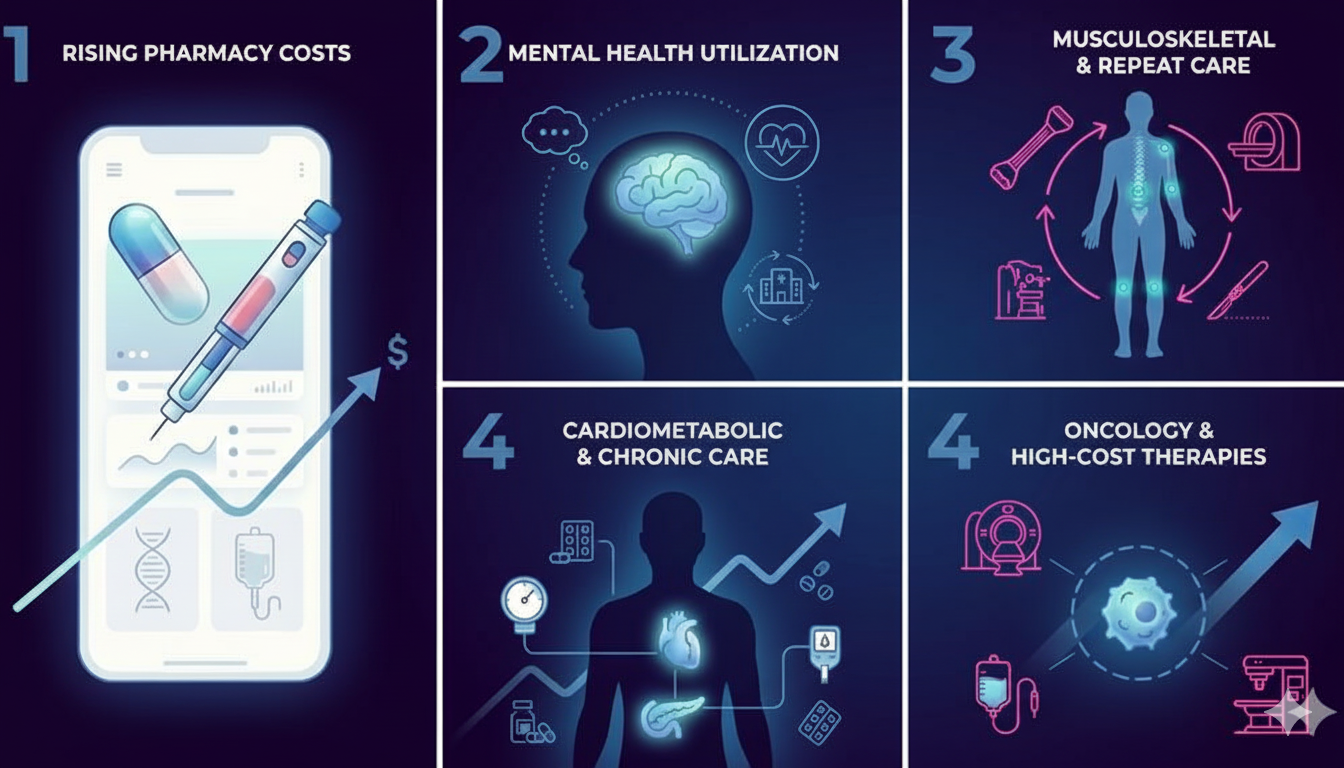
Top 5 Conditions Driving Employer Claims Costs in 2025
Abhishek Ghosh
December 17, 2025
2025 brought employers a rude awakening. Health-benefit costs are surging, and not because of old, predictable categories. Inflation, medical trend, and rising utilization all play a role, but the real increase comes from specialty drugs, advanced therapies, and rising demand across chronic and behavioral conditions. If you manage a benefits plan, you can expect an overall cost trend of 7–9%, and in many cases even higher if you do not act.
This isn’t a temporary shock. It’s a structural shift. For employers planning 2026 renewals and beyond, the question isn’t whether costs go up, but how much they go up. The organizations that get ahead will stop chasing point solutions and start building clinical, data-driven strategies.
In this post, we cover the five conditions hitting employer-sponsored plans hardest and why they matter.
Why Employer Claims Costs Are Rising in 2025
Macro Trends That No CFO Can Ignore
- Pharmacy spend is rising fast. According to a major 2025 employer-benefits survey, average family plan premiums reached $26,993, a 6% rise over 2024.
- Medical cost trends remain elevated. Insurers and actuaries project group-market medical cost trends at 7.5 to 8.5% for 2025 and 2026.
- Specialty drugs and new therapies are eating a larger share of spend. Rising use of advanced medications, including GLP-1s, is reshaping what “typical pharmacy spend” looks like.
- Behavioral health, chronic disease, and complex conditions are growing, both in prevalence and cost per case.
Taken together, these shifts force a new reality. The “average per-employee cost” no longer follows historical linear trends. A small group of high-cost claimants and high-cost therapies now dominate plan spend. As one 2025 industry survey notes, for 2026 employers expect a median cost increase of around 9% if they don’t adjust.
The Top 5 Conditions Driving Employer Claims Costs in 2025
Below are the five conditions and categories that most frequently top employer cost-driver lists in 2025, along with what they cost and how to fight back.
1. Specialty Drugs & GLP-1 Utilization
What’s happening
- New therapies, including GLP-1 weight-loss and diabetes drugs, advanced biologics, and other specialty medications, are becoming widespread. The use of GLP-1 receptor agonists has surged so sharply that many employers now list them among their top cost drivers.
- Pharmacy costs (drugs + specialty meds) are now a much larger component of total spend. For many plans, pharmacy constitutes 25–30% (or more) of overall spend, having grown substantially in recent years.
- According to a recent analysis, GLP-1 and other high-cost medications are not only increasing drug spend, they are also reshaping utilization patterns and long-term liability.
Why it matters (for employers)
- These are not one-time costs: many of these therapies require long-term commitment and recurring claims.
- The ROI on elective prescriptions such as GLP-1s for weight loss is uncertain. Discontinuation rates are high, weight regain is common, and long-term gains often do not offset the cost.
- If not managed, pharmacy spend alone can blow your budget.
Specialty Medications: Cost Mechanics Employers Should Know
This table breaks down how specialty drugs, including GLP-1s and advanced therapies, drive pharmacies through high prices, repeat utilization, and limited controls.
2. Behavioral Health & Substance Use
What’s happening
- As care access expands through in-person and telehealth options, utilization of behavioral health services such as therapy, psychiatry, and substance use treatment has increased sharply.
- Employers report behavioral health as a top condition driving 2025 cost increases, with notable overlap between behavioral health and other chronic or complex conditions that add to medical spend.
Why it matters
- Behavioral health often leads to comorbidities — untreated or poorly managed mental health can exacerbate chronic physical conditions, increasing overall claims.
- Inpatient stays, relapses, or repeated therapy cycles can generate high costs.
Behavioral Health: Cost Drivers Employers Can’t Ignore
This table shows how rising behavioral health utilization increases both direct mental-health costs and downstream medical claims across other conditions.
3. Musculoskeletal Conditions (MSK — back, joints, chronic pain)
What’s happening
- MSK issues remain one of the most common causes of chronic pain, disability, lost productivity, repeated outpatient visits, imaging, injections, PT, and surgeries.
- As people age and as more workers remain in the workforce longer, MSK prevalence rises, pushing these conditions among the top cost drivers for medical spend. While public data linking MSK-specific 2025 spending is still fragmented, its inclusion in chronic-condition and high-cost claim categories is leading many employers to flag MSK as a priority focus.
Why it matters
- MSK claims tend to be recurrent. Imaging, therapy, follow-up, and sometimes surgeries each add cost.
- Long-term MSK issues often lead to disability leaves, reducing productivity and increasing indirect workforce cost.
- Without early intervention, MSK management tends to gravitate toward invasive and high-cost care (e.g. surgeries), inflating claims.
Musculoskeletal Conditions: High Frequency, High Cost
This table explains why common MSK issues lead to repeated claims, disability leaves, and escalating medical and productivity costs for employers.
4. Cardiometabolic Disease (Diabetes, Obesity-Related Conditions, Heart Disease)
What’s happening
- Chronic cardiometabolic conditions remain widespread in working populations: diabetes, hypertension, obesity-related comorbidities, and early-onset cardiovascular risks.
- Combined with the rising use of weight-loss medications (GLP-1s), there’s higher demand for chronic-disease management, outpatient care, medication, and in some cases, catastrophic care for complications.
- Since chronic disease care is long-term and often lifelong, cost accumulation is gradual but persistent.
Why it matters
- Recurrent outpatient visits, continual medication, periodic diagnostics, and risk of acute events (heart attacks, hospitalizations) keeps employer liability high.
- Preventive care gaps or inconsistent adherence amplify long-term risk, increasing future costs.
- Employers paying blindly for coverage without active disease-management strategies often see cost drift compounding over years.
Cardiometabolic Disease: The Long-Tail Cost Problem
This table highlights how chronic cardiometabolic conditions create continuous medical spend and raise the risk of costly downstream events.
5. Cancer and Other Complex Chronic Conditions
What’s happening
- Oncology care, including diagnostics, precision medicine, infusions, outpatient facility services, and long-term treatments, continues to be among the highest-cost categories.
- Employers repeatedly cite cancer as a top condition driving cost increases year after year.
- As treatment moves increasingly to outpatient and precision-medicine settings, costs per claim have surged. These are often unpredictable, high-severity events.
Why it matters
- Single events can cost hundreds of thousands or more. Even a handful of cancer patients can drive a large portion of annual medical spend.
- Because incidence is low but severity is high, costs are difficult to manage, and the financial risk to employers remains substantial.
Without proper care pathways and vendor partnerships, employers can get hit by unchecked claim variability and catastrophic spend.
Cancer Care: Low Volume, High Financial Impact
This table outlines why a small number of cancer and complex chronic cases can drive outsized claims costs and budget volatility.
The Financial Impact: What This Means for Budgets
Let’s put numbers around it.
- According to a 2025 employer benefits survey, average family plan premiums rose 6%, pushing annual family coverage costs near $27,000.
- Without intervention, many employers expect healthcare spend to continue rising — 8–9% per year for 2025 and 2026.
- Given that high-cost claimants and high-cost therapies (specialty drugs, oncology, etc.) contribute a disproportionate share of spend, even a small number of claims can significantly sway plan liability.
For a mid-size employer, a handful of high-cost cases — a few chronic-disease patients, some specialty-drug users, and one or two complex-care cases — can effectively consume the entire year’s budget overrun margin.
Conclusion
Health costs in 2025 aren’t rising by accident. A small number of health problems are driving most employer claims. These include specialty drugs, long-term illnesses, mental health needs, muscle and joint pain, and complex treatments that now happen in more expensive settings. Employers who ignore these patterns will keep seeing higher bills year after year.
The idea behind Top 5 Conditions Driving Employer Claims Costs in 2025 is simple. Costs grow when care isn’t guided early. Pharmacy use, repeated treatments, and delayed care add up fast. When employers improve access, guide people to the right care, and track results, many of these costs can be reduced.
In the upcoming articles, we will take a deeper look at practical ways employers can control these costs and apply these strategies effectively.
Source:

The Renewal Meeting Playbook for Brokers
Abhishek Ghosh
December 17, 2025
Renewal meetings aren’t just about numbers — they’re about trust, strategy, and showing your client you’re looking out for them all year long.
If you walk in unprepared, you risk being seen as “just another broker.”
But if you walk in ready with insights, ideas, and options, you become an indispensable partner who helps them make smarter benefits decisions.
Here’s a simple, proven before–during–after game plan to nail your next renewal meeting.
Before the Meeting: Set the Stage
Think of the renewal meeting as your performance — and preparation as your rehearsal.
The more you understand their plan, their numbers, and their options, the more confident you’ll be when you walk in the door.
1. Dive Into the Data
Before you even think about solutions, you need to know the story the numbers are telling.
- Review claims trends to see where the money is going.
- Spot high-cost claims that might be influencing the renewal rates.
- Analyze plan utilization rates to find underused or overused benefits.
Tip: Visuals are your friend here. A simple bar chart or pie graph can make complex data instantly clear.
2. Benchmark Their Plan
Clients don’t always know how their benefits stack up — they just know what it costs them.
By benchmarking their plan against similar-sized companies and industry averages, you can show them exactly where they stand.
- Compare premium rates and contribution splits.
- Highlight both strengths and gaps.
3. Prepare Multiple Scenarios
Never walk into a renewal meeting with just one option. Give them choices that reflect different priorities.
- Create plan design variations that balance coverage and cost.
- Include voluntary benefits to boost employee satisfaction without a big budget hit.
- Explain the employee impact so they understand how changes affect the people using the benefits.
4. Check Compliance Updates
It’s easy for clients to overlook compliance — but that’s why they have you.
Come ready with a quick summary of changes in ACA regulations, state mandates, IRS limits, or mental health parity requirements. This not only shows your expertise but also builds trust.
During the Meeting: Win the Room
Once you’re in the meeting, your goal is to shift the conversation from renewal to strategy.
This is your moment to show you’re not just delivering news — you’re delivering solutions.
1. Start With the Big Picture
Don’t jump straight into rates. Start by walking them through the big picture: trends, benchmarks, and where they stand compared to the market. This gives context and helps them see the “why” behind the numbers.
2. Present Options, Not Just Numbers
When you give clients a single option, you’re forcing them into a corner. When you give them multiple scenarios, you put them in control.
- Show the trade-offs clearly — higher deductible for lower premiums, richer coverage for higher cost, etc.
- Keep the language simple and avoid benefits jargon.
- Connect each choice to company goals like cost control, retention, and employee well-being.
3. Address Savings Opportunities
This is where you can really shine as a problem-solver.
- Share any savings you negotiated with carriers.
- Suggest wellness programs or pharmacy benefit reviews that can reduce claims.
- If they’re ready, introduce alternative funding models like self-funding.
4. Keep Compliance on the Agenda
Even though it’s not the most exciting part of the meeting, a quick compliance check shows you’re protecting them from risk. Clients will remember that.
5. End With Clear Next Steps
Too many meetings end with “We’ll think about it.” Instead, make sure everyone knows the plan.
- Confirm decision deadlines.
- Review submission dates for carriers.
- Schedule open enrollment support sessions.
After the Meeting: Seal the Value
The meeting may be over, but the relationship work continues.
Following through after the meeting is what turns a good impression into long-term loyalty.
1. Send a Recap Email
Within 24 hours, send a clear, concise recap.
- Summarize what was discussed.
- Highlight agreed-upon next steps.
- Attach the charts, benchmarks, and plan comparisons you showed during the meeting.
2. Share Employee Communication Plans
Don’t wait until open enrollment to think about employee engagement.
Send over draft enrollment materials, FAQs, and an outline for education sessions. This shows you’re thinking about their people, not just their premiums.
3. Keep the Momentum Going
Check in regularly as deadlines approach. Offer reminders, updates, and progress reports so nothing falls through the cracks.
Final Word
When you prepare before the meeting, lead with strategy during it, and follow through after, you stop being “the broker who delivers renewals” and become “the partner who drives results.”
That’s the kind of broker clients don’t just renew with — they recommend.
Frequently Asked Questions (FAQ)
Why is a renewal meeting important for brokers?
A renewal meeting ensures your client understands their options, costs, and compliance requirements before making plan decisions. It’s also a chance to position yourself as a strategic partner, not just a messenger.
How far in advance should I prepare for a renewal meeting?
Ideally, start at least 60–90 days before the renewal date. This gives you time to analyze data, negotiate with carriers, and prepare multiple plan scenarios.
What compliance topics should be covered in the U.S.?
Key areas include:
- Affordable Care Act (ACA) reporting and coverage requirements
- ERISA plan documentation
- IRS limits for HSAs, FSAs, and retirement plans
- HIPAA privacy rules
- State-specific mandates (e.g., paid leave, disability coverage)
How can I make the meeting more engaging for clients?
Use simple visuals like charts, show the impact of changes on employees, and frame recommendations in terms of company goals (cost savings, retention, well-being).
What should I send after the meeting?
Send a concise recap email summarizing decisions, next steps, and deadlines. Attach supporting documents like plan comparisons, compliance summaries, and enrollment materials.
How can I handle pushback on plan changes?
Be transparent about the reasons for changes, provide data to support your recommendations, and offer alternative options that align with the client’s priorities.
Should I discuss voluntary benefits during renewal?
Yes. Voluntary benefits (like dental, vision, and supplemental insurance) can improve employee satisfaction without significantly increasing employer costs.

7 Steps to Turn a Benefits Renewal Meeting Into a Revenue Opportunity
Abhishek Ghosh
December 17, 2025
Benefits renewal season often becomes a routine process—review last year’s plan, adjust for rate changes, and move on. But savvy brokers know that renewals can be much more than just administrative check-ins. They're prime moments to deliver real value, deepen client relationships, and generate new revenue.
In this blog, we’ll show you how to transform each renewal meeting into a strategic opportunity. You’ll get a ready-to-use talk track, a detailed checklist, and practical ideas to grow your book of business—without sounding salesy.
Why Renewal Meetings Are Undervalued
For many brokers, renewal meetings feel like paperwork. But for your clients, this is when healthcare costs, coverage concerns, and employee satisfaction are front and center. That makes it the perfect time to step into a more strategic, consultative role.
Here’s why renewal meetings matter:
- HR and finance leaders are most engaged. They’re planning next year’s budgets and open to new ideas.
- Employee sentiment is top of mind. Open enrollment feedback is fresh and often shared with HR.
- Data is readily available. You can analyze last year’s usage to suggest smarter options.
Instead of sticking to rate comparisons and provider changes, elevate the conversation by aligning your services to their business goals.
Top 7 Revenue Opportunities at Renewal

If you want to go beyond “basic brokerage,” look for ways to add value that support cost control and employee satisfaction. Here are seven ways to do it:
1. Shift the Mindset From Renewal to Strategy
Most HR teams expect brokers to bring rate updates and plan comparisons. Surprise them by reframing the conversation:
“Let’s go beyond just renewing your benefits—this is a chance to revisit your strategy, optimize spend, and boost employee satisfaction.”
This simple shift sets you up as a consultative partner, not a vendor.
2. Use Census and Utilization Data to Uncover Insights
Analyze the client’s census and benefits usage data ahead of the meeting. Look for:
- Employees enrolled in misaligned plans
- Over-utilization of ER or urgent care
- Underused preventive services
- Gaps in dependent coverage or high spousal enrollment
Bring 2–3 actionable insights to show you’re proactively managing their plan.
3. Model ROI-Driven Plan Alternatives
Go beyond plan summaries. Show side-by-side comparisons that highlight:
- Total cost savings for the company
- Lower out-of-pocket costs for employees
- Estimated tax savings with HSA-compatible plans
This moves the discussion from “what’s changing” to “what’s possible.”
4. Upsell Voluntary Benefits With High Perceived Value
HR is open to new ideas—especially if they’re voluntary and easy to implement. Consider suggesting:
- Hospital indemnity or critical illness
- Financial wellness or identity protection
- Legal assistance, pet insurance, student loan support
These are value-adds that increase employee satisfaction and retention.
5. Introduce Year-Round Engagement Tools
Benefits shouldn't disappear after open enrollment. Offer tools like Slack or Microsoft Teams-based AI assistants that:
- Reduce HR support burden
- Increase benefit literacy
- Improve employee satisfaction year-round
Position these tools as a modern upgrade to the overall benefits experience.
6. Offer Add-On Services That Reduce Costs
Clients want help managing healthcare spend. Use the renewal to pitch strategic add-ons like:
- Dependent eligibility audits
- High-cost claims analysis
- Pharmacy benefits consulting
These tools help reduce costs and improve compliance without sounding like a sales pitch.
7. Add Executive Benefits or Leadership Enhancements
Executives have unique needs. Recommend specialized benefits such as:
- Long-term disability or supplemental life
- Concierge medical care or second opinion services
- Deferred compensation and retention programs
These enhancements increase leadership satisfaction and profitability for your brokerage.
Talk Track: How to Lead a Strategic Renewal Meeting

A strong talk track helps you run a strategic and consultative renewal meeting. Here’s a simple flow:
1. Set the Strategic Tone
“Thanks for making time today. Instead of just reviewing renewal rates, I’d love to take a broader look at your benefits strategy—what’s working, what could improve, and where we can find savings or boost satisfaction.”
2. Share Data-Driven Insights
“We analyzed your plan usage and census data. Here are a few trends that stood out:
- 12% of employees may be over-insured
- ER visits are up 30% year-over-year
- A large portion isn’t taking advantage of preventive care benefits”
3. Present ROI-Based Options
“We explored a few alternative plan designs. One option could save your company $6,500 a year while keeping deductible levels stable for 80% of your team.”
Use visuals: bar graphs, cost comparisons, and impact charts.
4. Introduce Value-Add Services
“We’ve seen similar companies benefit from adding financial wellness tools or hospital indemnity. They’re voluntary, easy to implement, and help with employee retention.”
5. Close With a Forward-Looking Statement
“Beyond this renewal, we’d love to help you build a benefits experience that supports your employees year-round. We have tools that can make that easy and automated.”
Renewal Meeting Checklist for Brokers
🔍 Before the Meeting
- Analyze census data by age, tier, and plan type
- Review claims or utilization reports
- Benchmark plans against industry standards
- Prepare 2+ optimized plan configurations
- Identify gaps or underutilized benefits
- Create visual plan comparison deck
💬 During the Meeting
- Set a strategic tone
- Present key insights and trends
- Highlight ROI from alternative plans
- Recommend at least one new service
- Introduce employee engagement tools
- Ask about executive benefit needs
📩 After the Meeting
- Send follow-up email with slides and recommendations
- Include pricing and implementation timelines
- Share employee communication templates
- Schedule Q1 or Q2 check-in
Tools That Make Renewal More Strategic
Here are four types of tools brokers can use to stand out:
📊 Census Analytics Software
Tools like BenOsphere CensusIQ help identify plan mismatches, cost gaps, and upsell opportunities using enriched employee profiles.
💬 AI Benefits Assistants
Use Slack, Teams, or SMS-based bots to answer employee questions year-round and reduce HR load.
📈 Plan Modeling Calculators
Show total cost of ownership (premium + deductible – HSA tax savings) to help clients make smarter decisions.
🕵️ Claims & Dependent Audit Tools
Spot overspending trends and identify ineligible dependents to proactively reduce costs.
Useful Resources
Final Thoughts
A renewal meeting isn’t just a contract check-in. It’s your best shot each year to:
✅ Reinforce your role as a trusted advisor
✅ Drive new revenue through value-adds
✅ Help clients reduce costs and improve coverage
✅ Deepen relationships and increase retention
With the right preparation, data, and tools, every renewal becomes a business development opportunity—not a formality.
Want to turn your renewals into ROI-generating strategy sessions?
👉 Book a demo with BenOsphere to explore census insights, AI-driven engagement tools, and benefit optimization strategies designed for modern brokers.

Who Is Eligible for SDI in California?
Abhishek Ghosh
December 24, 2024
Not knowing who is eligible for SDI in California can leave you feeling uncertain, especially when you need financial support during a time of illness or injury.
The last thing you want is to be caught unprepared when a disability interrupts your ability to work, whether it’s for a physical injury, mental health reasons, or pregnancy. Missing the window to apply or lacking the proper documentation could delay your benefits or result in a denial.
Understanding who is eligible for SDI in California is key. If you’ve paid into the program through payroll deductions, have a disability that prevents you from working for at least eight days, and have earned a minimum of $300 during your base period, you likely qualify. Special rules also apply for self-employed individuals and non-residents. Keep reading to learn exactly what you need to meet California's SDI eligibility requirements, ensuring you can secure the benefits you deserve when the time comes.
What is SDI?
California's State Disability Insurance (SDI) program provides temporary financial assistance to individuals unable to work due to a non-work-related illness, injury, or pregnancy. To qualify for these benefits, you must meet specific criteria related to your disability status, income, and employment history. Let's delve into the eligibility requirements for SDI in California.
What Qualifies as a Disability for California SDI?
The primary requirement for SDI eligibility is the presence of a disability that prevents you from performing your regular work duties. This disability can be physical or mental and must be certified by a licensed healthcare professional, such as a physician, nurse practitioner, or psychologist.
Examples of disabilities that may qualify for SDI include:
- Injuries or illnesses that require hospitalization or prolonged medical treatment
- Chronic conditions like cancer, heart disease, or autoimmune disorders
- Mental health issues, such as depression, anxiety, or post-traumatic stress disorder (PTSD)
- Pregnancy-related disabilities, including complications or recovery from childbirth
How Does California Define Disability?
According to the California Employment Development Department (EDD), a disability is defined as "any mental or physical illness or injury, including pregnancy, childbirth, or related medical condition, that prevents you from performing your regular or customary work." This definition is broad and encompasses a wide range of conditions that can temporarily impair your ability to work.
Income Requirements for SDI Eligibility
To be eligible for SDI benefits, you must have earned a minimum amount of wages from which SDI contributions were deducted. The specific income requirement varies based on your base period, which is a 12-month period used to determine your eligibility and benefit amount.
Generally, you must have earned at least $300 in wages from which SDI deductions were taken during your base period. Additionally, you must have been paid wages of at least $300 in one or more quarters of your base period.
Employment History and SDI
There is no specific duration of employment required to qualify for SDI benefits in California. However, you must have been employed and paid wages from which SDI contributions were deducted during your base period.
It's important to note that SDI eligibility is based on your earnings and contributions, not the length of your employment. Even if you have only worked for a short period, you may still be eligible for benefits if you meet the income requirements during your base period.
SDI for Self-Employed Individuals
Self-employed individuals, including independent contractors, freelancers, and small business owners, are not automatically covered by California's SDI program. However, they have the option to participate in the Elective Coverage program, which allows them to make voluntary contributions to SDI.
To be eligible for SDI benefits as a self-employed individual, you must:
- Enroll in the Elective Coverage program
- Pay the required SDI contributions for at least two years
- Meet the income and disability requirements
If you choose to participate in the Elective Coverage program, you can receive SDI benefits for disabilities that occur after the two-year waiting period.
Timing and Waiting Periods
There is a non-payable waiting period of seven days before you can begin receiving SDI benefits. This means that benefits will not be paid for the first seven days of your disability. However, if your disability lasts longer than 14 days, you may be eligible for retroactive payment for the waiting period.
Can You Receive SdI if You Are Receiving Unemployment Benefits?
No, you cannot receive SDI benefits if you are currently receiving unemployment insurance (UI) benefits from California or any other state. SDI and UI benefits are mutually exclusive, meaning you can only receive one type of benefit at a time.
If you become disabled while receiving UI benefits, you must stop claiming UI benefits and apply for SDI instead. Once your SDI claim is approved, you will receive SDI benefits instead of UI benefits for the duration of your disability.
Impact of Maternity Leave on SDI
Pregnancy and childbirth are considered disabilities under California's SDI program. If you are unable to work due to pregnancy or recovery from childbirth, you may be eligible for SDI benefits.
Are There Special Conditions for Pregnancy Under SDI?
Yes, there are specific conditions related to pregnancy and SDI eligibility:
- You can receive SDI benefits for up to four weeks before your expected due date and six weeks after childbirth for a normal delivery.
- If you have a cesarean section or other complications, you may be eligible for additional weeks of benefits, as determined by your healthcare provider.
- SDI benefits for pregnancy are capped at a maximum of 52 weeks.
Applying for California SDI
To apply for SDI benefits in California, you must complete the following steps:
- Obtain a Claim for Disability Insurance (DI) Benefits form from your employer, a physician or healthcare provider, or the EDD website.
- Complete the employee portion of the form and have your healthcare provider complete the medical certification section.
- Submit the completed form to the EDD, along with any required supporting documentation.
You can submit your SDI claim online through the EDD website or by mail. It's recommended to apply as soon as possible after becoming disabled to ensure timely processing of your claim.
Can Non-California Residents Qualify for California SDI?
No, non-California residents are not eligible for California's SDI program. To qualify, you must have worked and earned wages in California from which SDI contributions were deducted.
If you are a California resident but worked in another state, you may be eligible for that state's disability insurance program, if one exists. However, you cannot receive SDI benefits from California if you did not work and earn wages in the state.
Conclusion - Who Is Eligible for SDI in California?
Navigating the eligibility requirements for California's SDI program can be complex, but understanding the key criteria can help ensure a smooth application process. Remember, to qualify for SDI benefits, you must meet the disability, income, and employment history requirements, as well as adhere to the program's specific rules and regulations.
If you're unsure about your eligibility or have questions about the application process, consider consulting with a qualified legal professional or contacting the California Employment Development Department (EDD) for personalized assistance. Don't hesitate to seek guidance to ensure you receive the support you need during your period of disability. So, this concludes the topic about Who Is Eligible for SDI in California.
FAQs
Who is eligible for California SDI?
To be eligible for California SDI, you must have a disability that prevents you from doing your regular or customary work for at least eight days. You also need to have earned at least $300 during your base period, from which SDI deductions were withheld, and be under the care of a licensed physician. Additionally, you must submit your claim within 49 days of becoming disabled.
What is considered a disability for SDI?
A qualifying disability includes any physical or mental illness or injury that stops you from working. This can range from non-work-related injuries and illnesses to pregnancy and childbirth. Disabilities need to be verified by a licensed healthcare provider(
Can self-employed individuals apply for SDI?
Yes, self-employed individuals can apply for SDI if they have voluntarily opted into the Disability Insurance Elective Coverage (DIEC) program, which allows business owners and self-employed workers to contribute to the SDI fund and receive benefits when needed(
How much will I receive through SDI?
SDI payments provide about 60-70% of your wages earned in the base period, up to a maximum of $1,300 per week as of recent data. The exact amount depends on your previous earnings(
How long do SDI benefits last?
You can receive SDI benefits for up to 52 weeks for a single disability period. However, the actual duration depends on your specific medical condition and the certification from your healthcare provider(
Are there waiting periods for SDI benefits?
Yes, there is a seven-day unpaid waiting period before benefits begin. However, this waiting period may be waived in cases of pregnancy or other certain conditions(
Can I receive SDI if I am receiving workers' compensation?
In most cases, if you're receiving workers' compensation for a work-related injury, you cannot receive SDI benefits simultaneously. However, if workers' compensation pays less than SDI, you may qualify for SDI to cover the difference(
What happens if my SDI claim is denied?
If your claim is denied, you can appeal within 20 days of receiving the denial notice. You must submit a reconsideration request in writing and provide any additional documentation to support your claim(
Can non-California residents qualify for SDI?
Yes, non-California residents who work in the state and have paid SDI taxes can qualify for benefits as long as they meet other eligibility requirements(
Can undocumented workers receive SDI?
Yes, undocumented workers who have been paying into the SDI program are eligible for benefits, as citizenship status does not impact eligibility
References:
https://www.disabilityhelp.org

Do You Get Full Pay on Maternity Leave in California?
Abhishek Ghosh
December 24, 2024
Are you anxious about how much you’ll actually get paid during maternity leave in California? The idea of taking time off to care for your new baby is wonderful, but the uncertainty around your income can be a real source of stress.
Picture this: you’re preparing for one of the most exciting times in your life, but instead of enjoying the moment, you’re worried about making ends meet. Will you get full pay? How will you manage your bills? This nagging concern can overshadow the joy of welcoming your little one.
So, do you get full pay on maternity leave in California? Understanding the state’s maternity leave policies is key to answering this question and ensuring your finances stay on track while you focus on your growing family. By knowing your rights, you can plan confidently, knowing you’ll have the support you need during this precious time.
How Much Do You Get Paid on Maternity Leave in California?
The amount you receive during maternity leave in California depends on several factors, including your income, the length of your leave, and the specific programs you qualify for. Here's a breakdown of the primary sources of maternity leave pay in California:
- State Disability Insurance (SDI): This program provides partial wage replacement for employees who are unable to work due to pregnancy or childbirth-related disabilities. The SDI benefit amount is calculated based on your past earnings, with a maximum weekly benefit of $1,540 (as of 2023).
- Paid Family Leave (PFL): Once your pregnancy-related disability period ends, you may be eligible for PFL benefits, which provide partial wage replacement for bonding with a new child. Like SDI, the PFL benefit amount is based on your past earnings, with the same maximum weekly benefit of $1,540.
- Employer-Provided Benefits: Some employers offer additional maternity leave benefits, such as paid parental leave or short-term disability coverage. These benefits vary depending on the company's policies and may supplement or replace the state-provided benefits.
Is Maternity Leave Fully Paid in California?
While California offers various maternity leave benefits, it's important to understand that these benefits do not necessarily provide full pay during your leave. The SDI and PFL programs offer partial wage replacement, but the amount you receive may be less than your regular salary.
However, some employers in California do offer fully paid maternity leave as part of their benefits package. These policies vary from company to company, and it's essential to check with your employer to understand the specific maternity leave benefits they provide.
How Long is Paid Maternity Leave in California?
The length of paid maternity leave in California depends on several factors, including the specific programs you qualify for and your employer's policies. Here's a general overview:
- State Disability Insurance (SDI): You can receive SDI benefits for up to 52 weeks (one year) for any single pregnancy or childbirth-related disability. The typical duration for pregnancy-related disabilities is around 4-6 weeks before the due date and 6-8 weeks after childbirth (for a vaginal delivery).
- Paid Family Leave (PFL): Once your pregnancy-related disability period ends, you may be eligible for up to 8 weeks of PFL benefits for bonding with your new child.
- Employer-Provided Benefits: Some employers offer additional paid leave beyond the state-provided benefits. The duration of this leave varies depending on the company's policies.
It's important to note that the SDI and PFL benefits can be combined, but the total duration of paid leave cannot exceed the maximum allowed by each program.
What Percentage of Your Salary Do You Get During Maternity Leave in California?
The SDI and PFL programs in California provide partial wage replacement, typically ranging from 60% to 70% of your regular earnings, up to the maximum weekly benefit amount of $1,540 (as of 2023).
The specific percentage of your salary you'll receive during maternity leave depends on your income level and the program you're receiving benefits from. Here's a breakdown:
- State Disability Insurance (SDI): The SDI benefit amount is calculated based on your past earnings, with a maximum weekly benefit of $1,540. The benefit amount is approximately 60-70% of your regular earnings, depending on your income level.
- Paid Family Leave (PFL): The PFL benefit amount is also calculated based on your past earnings, with the same maximum weekly benefit of $1,540. The benefit amount is approximately 60-70% of your regular earnings, depending on your income level.
It's important to note that the SDI and PFL benefits are subject to certain deductions, such as federal and state income taxes, which may further reduce the amount you receive.
Can You Get Full Pay on Maternity Leave in California?
While the state-provided maternity leave benefits in California (SDI and PFL) offer partial wage replacement, it is possible to receive full pay during your maternity leave if your employer provides additional benefits.
Some employers in California offer fully paid maternity leave as part of their benefits package. These policies vary from company to company, and it's essential to check with your employer to understand the specific maternity leave benefits they provide.
If your employer does not offer fully paid maternity leave, you may be able to supplement the state-provided benefits with your accrued paid time off (PTO), such as vacation days or sick leave, to receive closer to your regular pay during your leave.
What Benefits Are Available During Maternity Leave in California?
In addition to the partial wage replacement provided by the SDI and PFL programs, California offers several other benefits to support new parents during their maternity leave:
- Job Protection: The California Family Rights Act (CFRA) provides job protection for eligible employees taking maternity leave. This means your employer must maintain your health insurance coverage and allow you to return to the same or a comparable position after your leave.
- Health Insurance Continuation: If you're covered under your employer's health insurance plan, you may be eligible to continue your coverage during your maternity leave through the California Family Rights Act (CFRA) or the federal Family and Medical Leave Act (FMLA).
- Pregnancy Disability Leave (PDL): The California Fair Employment and Housing Act (FEHA) provides up to four months of job-protected leave for pregnancy-related disabilities, which can be taken before or after childbirth.
- Lactation Accommodation: California law requires employers to provide reasonable break time and a private space (other than a bathroom) for lactating employees to express breast milk.
It's important to note that eligibility requirements and specific benefits may vary depending on your employer's policies and the programs you qualify for.
Does California Provide Any Additional Maternity Leave Benefits?
In addition to the federal Family and Medical Leave Act (FMLA), California offers its own set of maternity leave benefits through various state programs. The California Family Rights Act (CFRA) provides job-protected leave for employees, while the State Disability Insurance (SDI) program and Paid Family Leave (PFL) offer partial wage replacement during this time.
How Does California's Paid Family Leave (PFL) Work?
California's Paid Family Leave (PFL) program is a state-mandated insurance program that provides partial wage replacement for employees who need to take time off work to bond with a new child (including birth, adoption, or foster care placement).
Here's how the PFL program works:
- Eligibility: To be eligible for PFL benefits, you must have paid into the State Disability Insurance (SDI) program through payroll deductions and meet certain work and income requirements.
- Benefit Amount: The PFL benefit amount is approximately 60-70% of your regular earnings, up to the maximum weekly benefit of $1,540 (as of 2023).
- Duration: PFL benefits can be taken for up to 8 weeks within the first 12 months after the birth, adoption, or foster care placement of a new child.
- Coordination with Other Leave: PFL can be taken consecutively with SDI benefits for pregnancy-related disabilities or on its own for bonding with a new child.
- Job Protection: While PFL provides partial wage replacement, it does not offer job protection. However, if you're eligible for the California Family Rights Act (CFRA) or the federal Family and Medical Leave Act (FMLA), you may be entitled to job protection during your leave.
- Application Process: To apply for PFL benefits, you'll need to submit a claim form, along with supporting documentation, to the California Employment Development Department (EDD).
It's important to note that PFL benefits are separate from any additional paid parental leave or other benefits your employer may offer.
How Do I Apply for Maternity Leave Benefits in California?
To apply for maternity leave benefits in California, you'll need to follow these steps:
- Notify Your Employer: Inform your employer about your intention to take maternity leave and provide the necessary documentation, such as a medical certification or proof of the new child's birth or adoption.
- Apply for State Disability Insurance (SDI): If you're taking time off for pregnancy-related disabilities, you'll need to apply for SDI benefits through the California Employment Development Department (EDD). You can apply online, by mail, or in person at an EDD office.
- Apply for Paid Family Leave (PFL): Once your pregnancy-related disability period ends, you can apply for PFL benefits to receive partial wage replacement for bonding with your new child. You can apply online, by mail, or in person at an EDD office.
- Provide Supporting Documentation: You'll need to submit various supporting documents with your SDI and PFL applications, such as medical certifications, proof of income, and proof of the new child's birth or adoption.
- Coordinate with Your Employer: If your employer provides additional maternity leave benefits, make sure to coordinate with them and provide any necessary documentation to ensure you receive all the benefits you're entitled to.
It's important to apply for maternity leave benefits as early as possible to avoid any delays in receiving your benefits. Additionally, be sure to follow all instructions and deadlines provided by the EDD to ensure a smooth application process.
Conclusion- Do You Get Full Pay on Maternity Leave in California?
Navigating the various maternity leave benefits available in California can be complex, but understanding your rights and options is crucial for ensuring a smooth transition into parenthood. While the state-provided benefits, such as SDI and PFL, offer partial wage replacement, some employers may provide additional benefits to supplement these programs.
If you're an expectant mother in California, it's essential to familiarize yourself with the specific maternity leave policies and benefits offered by your employer, as well as the state-provided programs you may be eligible for. By taking the time to understand and plan for your maternity leave, you can better prepare for this exciting chapter in your life while minimizing any potential financial strain.
If you're an expectant mother in California and have questions or concerns about your maternity leave benefits, consider reaching out to a professional employment law attorney or a human resources consultant. They can provide personalized guidance and ensure you receive all the benefits and protections you're entitled to under state and federal laws.
For more information and resources on maternity leave in California, you can visit the following websites:
https://www.edd.ca.gov/disability/
https://www.dol.gov/agencies/whd/fmla

How Much Paid Time off Do You Get for Maternity Leave in California?
Abhishek Ghosh
December 24, 2024
Are you trying to figure out how much paid time off you get for maternity leave in California? It can be really confusing to sort through all the information, especially with different programs like Paid Family Leave (PFL) and State Disability Insurance (SDI) offering various benefits. You deserve clear answers, but it often feels like you're left in the dark.
You’ve got enough on your plate with a baby on the way—worrying about how much paid time off you get for maternity leave in California shouldn't be another burden. The stress of not knowing whether you’re getting the benefits you’re entitled to, or whether your job will be secure, can be overwhelming. It’s a time meant for joy, but uncertainty can cast a shadow over it.
Imagine having all the details about how much paid time off you get for maternity leave in California laid out for you, with no more guessing or stressing. You’ll know exactly what you qualify for, how to apply, and how to make the most of your leave. This knowledge will empower you to focus on what truly matters—preparing for your new arrival, confident that you’re getting the full benefits you deserve.
How Long Is Paid Maternity Leave in California?
The length of paid maternity leave in California depends on several factors, including your employer's policies, the specific state and federal laws that apply to your situation, and whether you qualify for state-provided benefits. In general, most employees in California are eligible for a combination of job-protected leave and partial wage replacement during their maternity leave.
What Maternity and Paternity Leave Does the CFRA Provide?
The California Family Rights Act (CFRA) is a state law that provides eligible employees with up to 12 weeks of job-protected leave during a 12-month period. This leave can be used for various reasons, including the birth or adoption of a child, caring for a family member with a serious health condition, or managing the employee's own serious health condition.
To qualify for CFRA leave, you must:
- Work for an employer with 5 or more employees
- Have been employed with the company for at least 12 months
- Have worked at least 1,250 hours during the 12-month period before the leave
It's important to note that CFRA leave is unpaid, but you may be eligible for partial wage replacement through other state programs, such as California Paid Family Leave (PFL) or State Disability Insurance (SDI).
How Much Pregnancy Leave Does the PDL Provide?
The Pregnancy Disability Leave (PDL) law in California provides additional protection for employees who are disabled due to pregnancy, childbirth, or related medical conditions. Under the PDL, eligible employees can take up to four months of job-protected leave, which can be taken before or after the actual birth of the child.
To qualify for PDL, you must:
- Be employed by a company with 5 or more employees
- Be unable to perform your job duties due to pregnancy, childbirth, or a related medical condition
Unlike CFRA leave, PDL is not limited to a specific time frame and can be taken intermittently or continuously, depending on your medical needs. Additionally, PDL leave is separate from CFRA leave, meaning you may be entitled to both types of leave, depending on your circumstances.
Is Maternity or Parental Leave Paid in California?
While CFRA and PDL provide job-protected leave, they do not guarantee paid leave. However, California offers several state-sponsored programs that can provide partial wage replacement during your maternity or parental leave.
California Paid Family Leave (PFL)
The California Paid Family Leave (PFL) program provides up to eight weeks of partial wage replacement benefits to employees who take time off work to bond with a new child or care for a seriously ill family member. To be eligible for PFL benefits, you must:
- Have paid into the State Disability Insurance (SDI) program through payroll deductions
- Have earned at least $300 in wages during your base period (the 12-month period used to calculate your benefits)
PFL benefits are typically 60-70% of your weekly wages, up to a maximum weekly benefit amount, which is adjusted annually.
State Disability Insurance (SDI)
The State Disability Insurance (SDI) program provides partial wage replacement benefits to employees who are unable to work due to a non-work-related illness or injury, including pregnancy and childbirth. To be eligible for SDI benefits, you must:
- Have paid into the SDI program through payroll deductions
- Be unable to perform your regular or customary work due to a disability
SDI benefits can provide up to 52 weeks of partial wage replacement, typically at a rate of 60-70% of your weekly wages, up to a maximum weekly benefit amount.
How Do I Apply for Maternity Leave Benefits in California?
To apply for maternity leave benefits in California, you'll need to follow these steps:
- Notify Your Employer: Provide your employer with written notice of your intention to take leave, including the anticipated start and end dates. Your employer may require you to provide medical certification or other documentation to support your leave request.
- Apply for State Benefits: If you plan to receive partial wage replacement through PFL or SDI, you'll need to submit an application to the California Employment Development Department (EDD). You can apply online, by mail, or in person at an EDD office.
- Provide Supporting Documentation: Along with your application, you'll need to provide documentation to support your claim, such as medical certifications, proof of income, and other relevant information.
- Wait for Approval: The EDD will review your application and supporting documentation and determine your eligibility for benefits. If approved, you'll receive a Notice of Computation detailing your weekly benefit amount and the duration of your benefits.
It's important to apply for benefits as soon as possible, as there may be waiting periods before you can start receiving payments.
How Many Weeks of Paid Maternity Leave Are Available in California?
The total number of weeks of paid maternity leave available in California can vary depending on your specific circumstances and the combination of state and federal programs you're eligible for. Here's a breakdown of the potential leave duration:
In some cases, these leave periods can be combined or taken consecutively, potentially providing several months of job protection and partial wage replacement. However, it's important to note that the specific duration and eligibility requirements may vary based on your individual circumstances and the laws and policies applicable to your employer.
What Is the Difference Between California Paid Family Leave (PFL) and State Disability Insurance (SDI)?
While both California Paid Family Leave (PFL) and State Disability Insurance (SDI) provide partial wage replacement benefits, they serve different purposes and have distinct eligibility requirements.
California Paid Family Leave (PFL)
PFL is designed to provide income replacement for employees who need to take time off work to bond with a new child or care for a seriously ill family member. The key features of PFL are:
- Provides up to 8 weeks of partial wage replacement benefits
- Benefits are available to bond with a new child or care for a seriously ill family member
- Eligibility is based on having paid into the SDI program through payroll deductions
- Benefits are typically 60-70% of your weekly wages, up to a maximum weekly benefit amount
State Disability Insurance (SDI)
SDI is a broader program that provides partial wage replacement benefits for employees who are unable to work due to a non-work-related illness or injury, including pregnancy and childbirth. The key features of SDI are:
- Provides up to 52 weeks of partial wage replacement benefits
- Benefits are available for disabilities related to pregnancy, childbirth, and recovery
- Eligibility is based on having paid into the SDI program through payroll deductions
- Benefits are typically 60-70% of your weekly wages, up to a maximum weekly benefit amount
While PFL and SDI are separate programs, they can be used in conjunction to provide more comprehensive coverage during maternity leave. For example, an employee may first receive SDI benefits during pregnancy and recovery from childbirth, followed by PFL benefits for bonding with the new child.
How Much Will I Be Paid During My Maternity Leave in California?
The amount you'll be paid during your maternity leave in California depends on several factors, including the specific state programs you're eligible for and your previous earnings.
Pregnancy Disability Leave (PDL)
PDL itself does not provide wage replacement benefits. However, if you're eligible for State Disability Insurance (SDI), you can receive partial wage replacement during your PDL leave.
California Paid Family Leave (PFL)
PFL benefits are typically calculated as 60-70% of your weekly wages, up to a maximum weekly benefit amount. The maximum weekly benefit amount is adjusted annually and is based on the state's average quarterly wage.
State Disability Insurance (SDI)
SDI benefits are also calculated as 60-70% of your weekly wages, up to a maximum weekly benefit amount. The maximum weekly benefit amount is the same as for PFL and is adjusted annually.
It's important to note that the wage replacement benefits provided by PFL and SDI are intended to partially replace your income, not fully replace your regular wages. Additionally, the specific benefit amount you receive will depend on your previous earnings and the maximum weekly benefit amount in effect at the time of your claim.
Does my employer have to pay me during maternity leave, or is it only through state programs?
In California, most employers are not required to provide paid maternity leave or pay employees during their leave period. However, some employers may choose to offer paid leave as part of their employee benefits package.
The state-sponsored programs, such as California Paid Family Leave (PFL) and State Disability Insurance (SDI), provide partial wage replacement benefits during maternity leave. These benefits are typically funded through employee payroll deductions and are administered by the California Employment Development Department (EDD).
If your employer does not offer paid maternity leave, you may be eligible for the following state benefits:
- Pregnancy Disability Leave (PDL): This law provides job-protected leave for up to four months for pregnancy-related disabilities, but it does not provide wage replacement benefits. However, you may be eligible for SDI benefits during your PDL leave.
- State Disability Insurance (SDI): SDI provides partial wage replacement benefits for employees who are unable to work due to a non-work-related illness or injury, including pregnancy and childbirth. To receive SDI benefits, you must have paid into the program through payroll deductions.
- California Paid Family Leave (PFL): PFL provides up to eight weeks of partial wage replacement benefits for employees who take time off work to bond with a new child or care for a seriously ill family member. To be eligible, you must have paid into the SDI program through payroll deductions.
While your employer is not required to pay you during your maternity leave, some companies may offer paid leave as part of their benefits package. It's always a good idea to check with your employer's human resources department or review your employee handbook to understand the specific policies and benefits available to you.
How Do I Take Time off to Care for My Baby?
Taking time off to care for your newborn or newly adopted child involves navigating various state and federal laws, as well as your employer's policies. Here are the steps you can take to ensure you have the necessary time off to bond with your baby:
- Understand Your Eligibility: Review the eligibility requirements for the California Family Rights Act (CFRA) and California Paid Family Leave (PFL) to determine if you qualify for job-protected leave and partial wage replacement benefits.
- Notify Your Employer: Provide your employer with written notice of your intention to take leave, including the anticipated start and end dates. Your employer may require you to provide supporting documentation, such as a birth certificate or adoption paperwork.
- Apply for State Benefits: If you plan to receive partial wage replacement through PFL, you'll need to submit an application to the California Employment Development Department (EDD). You can apply online, by mail, or in person at an EDD office.
- Coordinate with Your Employer: Work with your employer to coordinate your leave and ensure a smooth transition during your absence. Discuss any company policies or procedures related to maternity or parental leave.
- Explore Additional Options: If you're not eligible for CFRA or PFL, or if you need additional time off, explore other options such as using accrued paid time off (e.g., vacation days, sick leave) or requesting an unpaid leave of absence from your employer.
- Plan for Your Return: Before your leave ends, communicate with your employer about your planned return date and any accommodations or adjustments you may need upon returning to work.
Remember, taking time off to care for a new child is a protected right under state and federal laws. It's essential to understand your rights and responsibilities, as well as your employer's obligations, to ensure a smooth and stress-free experience during this important life event.
Conclusion - How Much Paid Time off Do You Get for Maternity Leave in California?
Navigating the complexities of maternity and parental leave in California can be challenging, but understanding the various state and federal laws can help ensure you receive the time off and financial support you need during this important life event.
By familiarizing yourself with programs like the California Family Rights Act (CFRA), Pregnancy Disability Leave (PDL), California Paid Family Leave (PFL), and State Disability Insurance (SDI), you can plan ahead and take the necessary steps to secure your leave and partial wage replacement benefits.
Remember, your employer may also offer additional benefits or policies related to maternity and parental leave, so it's always a good idea to review your employee handbook or consult with your human resources department.
With proper planning and a solid understanding of your rights and responsibilities, you can enjoy the precious time with your new child while minimizing financial stress and ensuring a smooth transition back to work. So, this concludes the topic about How Much Paid Time off Do You Get for Maternity Leave in California.

Are Teachers Eligible for Paid Family Leave in California?
Abhishek Ghosh
December 24, 2024
As a teacher, you spend your days caring for and educating others, but when it’s time to focus on your own family, do you know if you’re eligible for Paid Family Leave (PFL) in California?
Imagine planning to spend quality time with a new baby, deal with a family health crisis, or manage personal matters, only to find out that you might not be eligible for Paid Family Leave. The stress of navigating these waters without clear answers can add to the already heavy workload and emotional toll educators face.
In this blog, we’ll clear up your confusion surrounding Paid Family Leave for teachers. We’ll explore the eligibility criteria, how benefits vary by state, and what steps educators can take to ensure they receive the support they need.
By understanding your rights and options, you can better plan and manage your time away from the classroom with confidence. So, let us read more about the topic Are teachers eligible for Paid Family Leave in California.
What is Paid Family Leave?
California's Paid Family Leave (PFL) program provides eligible employees with partial wage replacement benefits when they need to take time off work to care for a seriously ill family member or bond with a new child. This state-mandated program allows workers to focus on their family obligations without worrying about losing their income completely.
What are the Benefits of Paid Family Leave in California?
Under California's PFL, you can receive approximately 60-70% of your weekly wages (up to a maximum weekly benefit amount) for up to eight weeks within a 12-month period. The duration and amount of benefits may vary depending on your specific circumstances and income level.
Eligibility Criteria for Teachers in California PFL
So, according to the topic Are teachers eligible for Paid Family Leave in California this section would be particularly important as it will clarify Eligibility Criteria for Teachers in California.
Basic Eligibility Requirements
To qualify for PFL benefits in California, you must meet the following basic requirements:
- Employment and Earnings: You must have been employed or actively looking for work in California during the previous 12 months and have earned at least $300 from which State Disability Insurance (SDI) deductions were withheld.
- Reason for Leave: Your leave must be for one of the following qualifying reasons:
- Bonding with a new child (birth, adoption, or foster care placement)
- Caring for a seriously ill family member (child, parent, parent-in-law, grandparent, grandchild, sibling, spouse, or registered domestic partner)
- Notice and Documentation: You must provide your employer with proper notice and submit the required documentation to support your claim for PFL benefits.
Specific Conditions for Teachers
In addition to the basic eligibility criteria, teachers in California may have specific conditions or requirements to meet, depending on their employment status and the type of educational institution they work for. Here are some common scenarios:
- Public School Teachers: If you are a teacher employed by a public school district or state-funded educational institution, you are typically eligible for PFL benefits as long as you meet the basic requirements mentioned above.
- Private School Teachers: Teachers working in private schools may also be eligible for PFL benefits, as long as their employer participates in the State Disability Insurance (SDI) program and deducts the necessary contributions from their paychecks.
- Substitute Teachers: Substitute teachers may qualify for PFL benefits if they have earned enough wages from which SDI contributions were deducted during the base period (the 12-month period used to determine eligibility).
It's important to note that eligibility criteria can vary based on specific circumstances, and it's always advisable to consult with your employer's human resources department or the California Employment Development Department (EDD) for the most up-to-date and accurate information.
Differences Between PFL and Maternity Leave for Teachers
Definition and Scope of Maternity Leave
Maternity leave, also known as pregnancy disability leave (PDL), is a separate type of leave specifically designed for pregnant employees. It provides job-protected leave and benefits for the period of time when a woman is unable to work due to pregnancy, childbirth, or related medical conditions.
Key Distinctions Between PFL and Maternity Leave
It's important to understand that maternity leave and PFL can sometimes be used concurrently or consecutively, depending on the specific circumstances and the employee's needs.
How to Apply for Paid Family Leave as a California Teacher
Step-by-Step Application Process
To apply for Paid Family Leave (PFL) benefits in California as a teacher, follow these steps:
- Notify Your Employer: Provide your employer with proper notice of your intent to take PFL, typically at least 30 days in advance if the leave is foreseeable.
- Obtain Required Forms: Download and complete the appropriate forms from the California Employment Development Department (EDD) website, such as the "Claim for Paid Family Leave (PFL) Benefits" form.
- Gather Supporting Documentation: Collect any necessary supporting documentation, such as proof of your relationship to the family member you'll be caring for, or documentation related to the birth or adoption of a new child.
- Submit Your Claim: Submit your completed claim form and supporting documentation to the EDD by mail or online through their website.
- Wait for Approval: The EDD will review your claim and notify you if additional information is needed. Once approved, you'll receive a Notice of Computation outlining your weekly benefit amount and the maximum duration of your PFL benefits.
- Provide Updates: If your situation changes or you need to extend your leave, be sure to notify the EDD and provide any additional documentation they may require.
Required Documentation
The specific documentation required for your PFL claim may vary depending on your reason for taking leave. However, some common documents you may need to provide include:
- Proof of your relationship to the family member you'll be caring for (e.g., birth certificate, marriage certificate)
- Medical certification or documentation from a healthcare provider for a seriously ill family member
- Birth certificate or adoption paperwork for bonding with a new child
- Proof of your employment and earnings history
It's crucial to carefully review the instructions provided by the EDD and submit all required documentation to ensure a smooth and timely processing of your claim.
Paid Family Leave Benefits for Teachers in California
Financial Benefits and Compensation
As a teacher in California, if you are approved for Paid Family Leave (PFL) benefits, you can receive approximately 60-70% of your weekly wages (up to a maximum weekly benefit amount) for the duration of your approved leave period. The exact benefit amount is based on your highest quarter of earnings from the base period (the 12-month period used to determine eligibility).
Duration and Coverage of PFL
PFL benefits in California can provide up to eight weeks of partial wage replacement within a 12-month period. This leave can be taken all at once or intermittently, depending on your specific needs and circumstances.
It's important to note that PFL benefits are separate from any other leave or disability benefits you may be entitled to, such as maternity leave or sick leave. In some cases, you may be able to coordinate and use these benefits consecutively or concurrently, depending on your situation and the policies of your employer and the state.
Impact of PFL on Teacher Salaries in California
How PFL Affects Salary and Benefits
While on Paid Family Leave (PFL), your regular salary from your employer will be temporarily reduced or suspended, as you'll be receiving partial wage replacement benefits from the state's PFL program. However, it's important to note that PFL benefits are generally considered taxable income, and appropriate deductions will be made for state and federal taxes.
Additionally, your employer may continue to provide certain benefits, such as health insurance coverage, during your PFL leave. However, policies regarding benefit continuation and employee contributions may vary from one employer to another.
Understanding Deductions and Taxes
As mentioned earlier, PFL benefits are considered taxable income, and you'll be responsible for paying applicable state and federal taxes on these benefits. The California Employment Development Department (EDD) will deduct the necessary taxes from your PFL benefit payments, similar to how taxes are deducted from your regular paychecks.
It's essential to understand that your PFL benefits may be subject to additional deductions, such as for state disability insurance (SDI) contributions or other mandatory deductions, depending on your specific circumstances and the policies of the EDD.
Balancing Teaching Responsibilities and PFL
Strategies for Managing Workload
Taking Paid Family Leave (PFL) as a teacher can present unique challenges when it comes to managing your workload and responsibilities. Here are some strategies to consider:
- Communicate with School Administration: Discuss your plans for PFL with your school's administration well in advance. This will allow them to make necessary arrangements for substitute teachers or reassign your duties temporarily.
- Prepare Lesson Plans and Materials: If possible, prepare detailed lesson plans, teaching materials, and instructions for the substitute teacher or colleagues who will be covering your classes during your absence.
- Utilize Technology: Explore options for remote communication or virtual classroom tools that can help you stay connected with your students and colleagues during your leave, if appropriate and permitted by your school's policies.
- Seek Support from Colleagues: Reach out to fellow teachers or department heads for advice and support in managing your workload before and after your PFL leave.
Communicating with School Administration
Effective communication with your school's administration is crucial when taking Paid Family Leave (PFL) as a teacher. Here are some tips:
- Provide Ample Notice: Inform your school's administration about your plans for PFL as early as possible, ideally at least 30 days in advance if the leave is foreseeable.
- Discuss Arrangements: Work with your administrators to discuss arrangements for substitute teachers, lesson plan handover, and any other necessary preparations for your absence.
- Clarify Expectations: Understand your school's policies and expectations regarding communication, lesson planning, and other responsibilities during your PFL leave.
- Stay in Touch: Establish a communication plan with your administrators to provide updates or address any concerns that may arise during your leave.
- Seek Support: If you encounter any challenges or need additional assistance, don't hesitate to reach out to your school's administration or human resources department for support.
California State Disability Insurance (SDI) and Teachers
Overview of SDI
California's State Disability Insurance (SDI) program provides short-term disability benefits to eligible workers who are unable to work due to non-work-related illnesses or injuries, including pregnancy and childbirth. SDI benefits can provide partial wage replacement for up to 52 weeks, depending on the specific circumstances.
How SDI Interacts with PFL for Teachers
For teachers in California, SDI and Paid Family Leave (PFL) benefits can sometimes be used in conjunction or consecutively, depending on the specific situation. Here's how they may interact:
Maternity Leave
If you are a pregnant teacher, you may be eligible for SDI benefits during the period when you are unable to work due to pregnancy or childbirth-related complications. These benefits can be used before or after your PFL leave for bonding with your new child.
Caring for a Seriously Ill Family Member
If you need to take time off work to care for a seriously ill family member, you may be able to use SDI benefits if you are also unable to work due to your own illness or injury. Once you've recovered, you can then transition to PFL benefits to continue caring for your family member.
Coordination of Benefits
In some cases, you may be able to receive SDI and PFL benefits concurrently, depending on your specific circumstances and the policies of the California Employment Development Department (EDD).
It's important to carefully review the eligibility criteria and requirements for both SDI and PFL, and consult with the EDD or your employer's human resources department to understand how these benefits can be coordinated and utilized in your specific situation.
Common Challenges for Teachers Applying for PFL
Typical Obstacles and How to Overcome Them
While the Paid Family Leave (PFL) program in California is designed to support teachers and other eligible employees, there may be some common challenges or obstacles that arise during the application process. Here are some typical challenges and strategies to overcome them:
Incomplete or Incorrect Documentation
Ensure that you carefully review the required documentation and submit all necessary forms and supporting materials to avoid delays or denials in your PFL claim. If you're unsure about any requirements, don't hesitate to reach out to the California Employment Development Department (EDD) for clarification.
Eligibility Concerns
If you're unsure whether you meet the eligibility criteria for PFL benefits, consult with the EDD or your employer's human resources department. They can help you understand the specific requirements and provide guidance on how to demonstrate your eligibility.
Employer Resistance or Lack of Support
In some cases, employers may be unfamiliar with PFL or hesitant to accommodate your leave request. Educate yourself on your rights and responsibilities, and communicate openly with your employer to address any concerns or misunderstandings.
Balancing Work and Family Responsibilities
As a teacher, managing your workload and responsibilities during PFL can be challenging. Develop a plan with your school's administration, prepare lesson plans and materials in advance, and explore options for remote communication or virtual classroom tools, if appropriate.
Real-World Examples and Solutions
To better understand the challenges teachers may face when applying for PFL, consider the following real-world examples and potential solutions:
Example 1
A high school English teacher, who has been employed for several years, plans to take PFL to care for her elderly mother who has been diagnosed with a serious illness. However, she is unsure if she meets the eligibility criteria for PFL benefits.
Solution
The teacher should review the eligibility requirements carefully and consult with the EDD or her school district's human resources department to ensure she has met the necessary employment and earnings criteria. She should also gather any required documentation, such as medical certification from her mother's healthcare provider, to support her PFL claim.
Example 2
A kindergarten teacher, who recently adopted a child, faces resistance from his school's administration when requesting PFL for bonding with his new child. The administration is unfamiliar with the PFL program and is hesitant to approve his leave request.
Solution
The teacher should educate himself on his rights under the PFL program and provide the school administration with information and resources from the EDD or other authoritative sources. He should also communicate openly with the administration to address any concerns or misunderstandings and work together to develop a plan for managing his responsibilities during his PFL leave.
By being proactive, seeking guidance from appropriate resources, and communicating effectively with all parties involved, teachers can overcome common challenges and successfully navigate the PFL application process.
Support Resources for Teachers on PFL in California
Local and State Resources Available
So, based on the topic Are teachers eligible for Paid Family Leave in in California, as a teacher in California, you have access to various local and state resources that can provide support and guidance throughout the Paid Family Leave (PFL) process. Here are some valuable resources to consider:
California Employment Development Department (EDD)
The EDD is the state agency responsible for administering the PFL program. They offer comprehensive information, forms, and assistance for applying for and understanding PFL benefits. You can visit their website at https://www.edd.ca.gov or contact them directly for personalized support.
School District Human Resources Department
Your school district's human resources department can be a valuable resource for understanding your specific rights and obligations as a teacher regarding PFL. They can provide guidance on your district's policies, procedures, and any additional benefits or support available.
Local Teachers' Unions or Associations
Many teachers' unions or professional associations offer resources and support services for their members, including information on leave programs like PFL. These organizations can provide guidance, advocate on your behalf, and connect you with other teachers who have navigated the PFL process.
Community Organizations and Non-Profits
Depending on your location, there may be local community organizations or non-profit groups that offer support services, legal assistance, or advocacy for workers seeking to access family leave benefits like PFL.
Professional Organizations and Support Groups
In addition to local and state resources, there are various professional organizations and support groups that can be invaluable for teachers navigating the PFL process:
National Education Association (NEA)
The NEA is a national organization representing public school teachers and education support professionals. They offer resources and guidance on various employment-related issues, including family leave programs like PFL.
American Federation of Teachers (AFT)
The AFT is another national union representing teachers and other educational professionals. They provide information and support services for their members, including guidance on accessing family leave benefits.
Online Teacher Support Groups
There are numerous online communities and forums where teachers can connect, share experiences, and seek advice from peers who have gone through the PFL process. These groups can be invaluable for gaining insights, tips, and emotional support.
Parenting or Caregiving Support Groups
Depending on your specific reason for taking PFL (e.g., bonding with a new child or caring for a family member), there may be local or online support groups focused on parenting or caregiving that can provide valuable resources and a sense of community.
Utilizing these support resources can help teachers navigate the complexities of the PFL application process, understand their rights and responsibilities, and gain access to valuable guidance and support throughout their leave.
Conclusion - Are teachers eligible for Paid Family Leave in in California?
Paid Family Leave (PFL) in California is a valuable benefit for teachers who need to take time off work to care for a new child or a seriously ill family member. Understanding whether teachers in California are eligible for Paid Family Leave, along with the eligibility criteria and application process, is crucial. By utilizing the resources and support available, you can navigate the PFL system with confidence and ensure a smooth transition during your leave.
Remember, taking advantage of PFL not only provides financial security but also allows you to prioritize your family's well-being without sacrificing your teaching career. Communicate openly with your school's administration, prepare thoroughly, and don't hesitate to seek guidance from local and state resources, professional organizations, or support groups.
Ultimately, the PFL program recognizes the importance of work-life balance and aims to support teachers like you during these pivotal moments in your personal and family life.
Embrace this opportunity to care for your loved ones while maintaining your commitment to education, knowing that your job and income are protected during your absence. So, this concludes the topic about Are teachers eligible for Paid Family Leave in in California.
FAQ
What is Paid Family Leave (PFL) in California?
Paid Family Leave (PFL) in California provides eligible employees with partial wage replacement for up to 8 weeks to bond with a new child, care for a seriously ill family member, or manage military exigencies. It is funded through employee payroll deductions and administered by the state's Employment Development Department (EDD).
Are teachers in California eligible for Paid Family Leave?
Yes, teachers in California are generally eligible for Paid Family Leave if they have paid into the State Disability Insurance (SDI) program through payroll deductions. Most public school teachers participate in this program, making them eligible for PFL benefits.
How do I know if I’ve paid into the State Disability Insurance (SDI) program?
You can check your pay stubs or consult your school district’s payroll department to confirm if SDI deductions are being made. This deduction is typically listed as “CASDI” on pay stubs.
What is the benefit amount for Paid Family Leave?
The benefit amount is approximately 60-70% of your weekly wages, depending on your income. The EDD calculates the exact amount based on your highest-earning quarter in the base period.
How long can I receive Paid Family Leave benefits as a teacher?
Eligible teachers can receive PFL benefits for up to 8 weeks within a 12-month period. This time can be taken consecutively or intermittently.
Can I use Paid Family Leave for my own medical condition?
No, PFL benefits are not for your own medical condition. However, you may be eligible for State Disability Insurance (SDI) benefits if you are unable to work due to your own serious health condition.
How do I apply for Paid Family Leave as a teacher in California?
You can apply for PFL through the EDD website by completing the necessary forms online or by mail. You’ll need to provide personal information, employment details, and medical certification (if applicable).
Does Paid Family Leave affect my sick leave or vacation time?
No, PFL is separate from your accrued sick leave or vacation time. However, some school districts may require you to use available sick leave before accessing PFL benefits.
What should I do if my school district doesn’t participate in SDI?
If your district doesn’t participate in SDI, you may not be eligible for state-administered PFL. However, you should check if your district offers a private short-term disability or family leave benefit.
Can I receive Paid Family Leave benefits if I take a leave of absence from teaching?
Yes, as long as you meet the eligibility criteria, including paying into SDI and having sufficient earnings in your base period, you can receive PFL benefits even during a leave of absence.
References:

What Is a Clawback on Maternity Pay?
Abhishek Ghosh
December 24, 2024
As an expectant or new parent navigating the complexities of maternity leave, you may have encountered the term "clawback" in relation to your maternity pay. This concept can be confusing and raise concerns about your rights and obligations. In this comprehensive guide, we will demystify the clawback policy, explore its legal framework in California, and provide insights into best practices for both employees and employers. So, let us read more about the topic What is Clawback on Maternity Pay.
What is a Clawback Policy?
A clawback policy is a provision that allows an employer to recoup or recover a portion or all of an employee's maternity pay under certain circumstances. It essentially means that if specific conditions are met, the employee may be required to repay the maternity benefits they received from their employer. Understanding the nuances of a clawback policy is crucial for ensuring fair and transparent practices.
Understanding California Maternity Leave Clawback
In California, maternity leave and associated benefits are governed by a complex web of state and federal laws, including the California Family Rights Act (CFRA), the Pregnancy Disability Leave Law (PDLL), and the Fair Employment and Housing Act (FEHA). These laws aim to protect the rights of expectant and new mothers while also providing guidelines for employers.
Clawback Maternity Pay California Law
The legal framework surrounding clawback policies for maternity pay in California is intricate and subject to various interpretations. While there are no specific laws prohibiting or mandating clawback clauses, employers must ensure that their policies comply with broader employment laws and regulations. It is essential to consult with legal professionals to ensure compliance and avoid potential violations.
Scenarios Leading to Maternity Pay Refund in California
There are several scenarios in which an employer may invoke a clawback clause and seek a refund of maternity pay from an employee. These can include:
- Early Termination or Resignation: If an employee voluntarily resigns or is terminated shortly after returning from maternity leave, the employer may seek to recoup the maternity pay provided during the leave period.
- Failure to Return: If an employee fails to return to work after their maternity leave, the employer may require repayment of the maternity pay received.
- Breach of Employment Agreement: Some employment contracts may include clawback provisions that are triggered if the employee breaches specific terms or conditions outlined in the agreement.
- Fraudulent or Improper Claims: If it is discovered that an employee obtained maternity pay through fraudulent means or misrepresentation, the employer may seek reimbursement.
Key Elements of a Clawback Clause in Maternity Pay
When implementing a clawback policy for maternity pay, employers should ensure that the clause is clear, unambiguous, and complies with applicable laws. Key elements to consider include:
- Specific Triggers: Clearly define the circumstances under which the clawback clause will be invoked, such as early termination, failure to return, or breach of contract.
- Repayment Terms: Outline the terms and conditions for repayment, including the amount to be repaid, the timeframe for repayment, and any applicable interest or penalties.
- Notice Requirements: Specify the notice period and communication channels for informing employees about the clawback policy and any potential repayment obligations.
- Exceptions and Limitations: Consider including exceptions or limitations to the clawback policy, such as situations involving medical emergencies, family crises, or other extenuating circumstances.
Maternity Leave Pay Return: When and How
If a clawback clause is triggered, the employer must follow proper procedures to initiate the maternity pay return process. This typically involves:
- Providing Written Notice: The employer should provide the employee with a written notice outlining the specific reasons for invoking the clawback clause, the amount to be repaid, and the repayment terms.
- Offering a Repayment Plan: In some cases, employers may offer a reasonable repayment plan to accommodate the employee's financial situation, rather than demanding immediate repayment in full.
- Adhering to Legal Requirements: The employer must ensure that the clawback process complies with all applicable laws and regulations, including those related to wage deductions and employee rights.
Navigating California Employment Law on Clawback Maternity
So, as per What is a Clawback on Maternity pay navigating the complexities of CaliforniaSo, as per What is a Clawback on Maternity Pay, navigating the complexities of California employment law regarding clawback policies for maternity pay can be challenging. It is crucial for both employees and employers to understand their rights and responsibilities.
Employees may seek guidance from legal professionals or advocacy groups to ensure their rights are protected, while employers should consult with experienced employment attorneys to ensure compliance and mitigate potential risks.
Maternity Pay Recoupment Procedures in California
If an employer initiates the maternity pay recoupment process, employees should be aware of their rights and options. This may include:
- Requesting a Review: Employees may request a review of the clawback decision, particularly if they believe there are extenuating circumstances or if the employer has not followed proper procedures.
- Negotiating Repayment Terms: If the repayment terms are unreasonable or pose financial hardship, employees may negotiate more favorable terms with their employer.
- Seeking Legal Assistance: In cases where an employee believes their rights have been violated or the clawback policy is unlawful, seeking legal assistance from an employment attorney may be necessary.
Returning Maternity Pay: Employee Rights and Employer Responsibilities
Both employees and employers have specific rights and responsibilities when it comes to returning maternity pay under a clawback policy:
Employee Rights:
- The right to be informed about the clawback policy and its terms
- The right to challenge or appeal the clawback decision
- The right to negotiate reasonable repayment terms
- The right to seek legal assistance if necessary
Employer Responsibilities:
- Clearly communicating the clawback policy and its terms to employees
- Ensuring compliance with applicable laws and regulations
- Providing written notice and following proper procedures
- Offering reasonable repayment options and accommodating extenuating circumstances
- Maintaining accurate records and documentation
Implications of Clawback Maternity Benefits in California
The implementation of clawback policies for maternity benefits can have significant implications for both employees and employers in California:
For Employees:
- Financial burden and potential hardship if required to repay maternity pay
- Potential impact on job security and future employment prospects
- Increased stress and anxiety during an already challenging time
For Employers:
- Potential legal risks if policies are not compliant with employment laws
- Administrative and financial costs associated with implementing and enforcing clawback policies
- Potential negative impact on employee morale, retention, and recruitment efforts
Best Practices for Employers: California Clawback Maternity Policy
So, according to the topic What is a Clawback on Maternity Pay, to mitigate risks and ensure fair and transparent practices, employers in California should consider the following best practices when implementing a clawback policy for maternity pay.:
- Consult Legal Experts: Work closely with experienced employment attorneys to ensure compliance with state and federal laws, and to craft legally sound and enforceable clawback policies.
- Clear Communication: Clearly communicate the clawback policy and its terms to employees, preferably in writing and during the onboarding process or before the commencement of maternity leave.
- Reasonable Terms: Ensure that the clawback policy and repayment terms are reasonable and do not impose undue financial hardship on employees.
- Consistent Application: Apply the clawback policy consistently and without discrimination, ensuring that all employees are treated fairly and equitably.
- Flexible Repayment Options: Offer flexible repayment options, such as installment plans or deductions from future paychecks, to accommodate employees' financial situations.
- Documented Procedures: Establish clear and documented procedures for invoking the clawback clause, providing notice, and facilitating repayment.
- Regular Policy Review: Regularly review and update the clawback policy to ensure compliance with evolving laws and regulations, and to incorporate feedback and best practices.
Conclusion - What Is a Clawback on Maternity Pay?
The concept of clawback policies for maternity pay in California can be complex and nuanced. While employers have legitimate interests in protecting their investments, it is crucial to balance these interests with the rights and well-being of employees. By fostering open communication, adhering to legal requirements, and implementing fair and transparent policies, both employers and employees can navigate the challenges of maternity leave with confidence and respect.
If you have any concerns or questions regarding clawback policies for maternity pay in California, we encourage you to seek professional legal advice. So, this concludes the topic about What is a Clawback on Maternity Pay.
FAQs
What is a clawback on maternity pay?
A clawback on maternity pay is a provision that allows an employer to recover all or part of the maternity pay that has been paid to an employee. This usually happens if the employee does not meet specific conditions, such as returning to work for a minimum period after maternity leave.
How does a clawback clause work in California?
In California, clawback clauses must comply with state labor laws. Typically, an employer may require that an employee return to work for a certain period after maternity leave to keep the full maternity pay. If the employee resigns before completing this period, the employer may enforce a clawback to recover some or all of the maternity pay.
Is a clawback on maternity pay legal in California?
Yes, a clawback on maternity pay can be legal in California if it is clearly stated in the employment contract or maternity policy. However, the terms must comply with California labor laws, which protect employee rights and ensure that wage deductions are lawful.
Can an employer ask for maternity pay to be returned if I don’t come back to work?
Yes, if your contract includes a clawback provision, your employer may ask for the return of maternity pay if you choose not to return to work after your maternity leave. This often applies if the leave was paid in addition to the statutory minimum or was part of an employer-provided benefit.
What are the common conditions that trigger a maternity pay clawback?
Common conditions include:
- Not returning to work after maternity leave.
- Returning but not staying for the agreed-upon period (e.g., six months).
- Violating any terms specified in the clawback clause.
Can I negotiate the terms of a clawback clause?
Yes, in many cases, you can negotiate the terms of a clawback clause when discussing your maternity leave or employment contract. It’s advisable to seek legal advice to ensure the terms are fair and comply with state laws.
How can I avoid a clawback on my maternity pay?
To avoid a clawback, ensure that you fulfill any return-to-work obligations specified in your contract. If you’re unsure about the terms, consult your HR department or a legal professional.
What should I do if my employer enforces a clawback on my maternity pay?
If your employer enforces a clawback and you believe it’s unjust or unlawful, you should review your contract and seek legal advice. In California, you have the right to challenge any deductions that you believe violate state labor laws.

Do I Have to Pay Back My Maternity Leave in California?
Abhishek Ghosh
December 24, 2024
In California, employees are entitled to specific rights and protections when it comes to taking maternity leave. The state's laws aim to support new parents and ensure they can take the necessary time off without facing undue financial hardship or job insecurity. However, some employees may find themselves in a situation where their employer requests repayment of maternity leave benefits, leaving them uncertain about their obligations and rights.
California's maternity leave laws are designed to provide employees with job-protected time off to bond with their newborn or newly adopted child. The California Family Rights Act (CFRA) and the Pregnancy Disability Leave (PDL) law are the primary statutes governing maternity leave in the state. These laws outline the duration of leave, job protection, and other essential provisions.
It's crucial to understand that the specific terms and conditions of your maternity leave, including any potential repayment requirements, may be outlined in your employer's policies or employment contract. While state laws provide a baseline of protections, some employers may have additional clauses or agreements in place.
Employer Maternity Leave Policies and Contracts
Many employers in California have established maternity leave policies that outline the terms and conditions of leave, including any potential repayment requirements. These policies may be included in your employee handbook or employment contract.
When you begin your maternity leave, it's essential to review your employer's policies and any contractual agreements carefully. Pay close attention to clauses that address the following:
- Duration of maternity leave
- Paid or unpaid leave
- Eligibility requirements
- Conditions for repayment of maternity pay or benefits
Some employers may require employees to sign a separate agreement or contract specific to maternity leave, which outlines the terms and conditions, including any potential repayment obligations.
It's crucial to read and understand these documents thoroughly before signing or accepting them. If you have any questions or concerns, it's advisable to seek clarification from your employer or consult with a legal professional.
Maternity Pay Conditions: What You Need to Know
In California, some employers offer paid maternity leave benefits to their employees. These benefits may come in the form of a percentage of your regular pay or a fixed amount during your leave period.
When receiving paid maternity leave benefits, it's essential to understand the conditions attached to these payments. Some employers may require repayment of maternity pay in certain circumstances, such as:
- Failure to return to work: If you do not return to work after your maternity leave, your employer may require you to repay the maternity pay you received during your leave.
- Early termination: If you voluntarily resign or are terminated for cause shortly after returning from maternity leave, your employer may seek repayment of the maternity pay.
- Minimum service requirement: Some employers may have a minimum service requirement after your return from maternity leave. If you fail to meet this requirement, you may be obligated to repay the maternity pay.
It's essential to review the specific conditions outlined in your employer's policies or employment contract to understand when repayment of maternity pay may be required.
Maternity Pay Clawback: When Repayment May Be Required
In certain situations, your employer may request repayment of maternity pay or benefits, a practice known as a clawback. Here are some common scenarios where a clawback may occur:
Voluntary resignation or termination
If you voluntarily resign or are terminated for cause shortly after returning from maternity leave, your employer may seek repayment of the maternity pay or benefits you received during your leave.
Failure to return to work
If you do not return to work after your maternity leave, your employer may require you to repay the maternity pay or benefits you received.
Failure to meet service requirements
Some employers may have a minimum service requirement after your return from maternity leave. If you fail to meet this requirement, you may be obligated to repay the maternity pay or benefits.
Breach of contract or policy
If you violate the terms of your employment contract or the company's maternity leave policy, your employer may seek repayment of the maternity pay or benefits.
It's crucial to review your employer's policies and any contractual agreements carefully to understand the specific circumstances under which a clawback may occur.
Returning to Work After Maternity Leave: Navigating Employer Expectations
After taking maternity leave, returning to work can be a significant transition. Your employer may have certain expectations and requirements for your return, which could potentially impact your obligation to repay maternity pay or benefits.
Here are some key considerations:
Returning to the same or equivalent position
Under California law, your employer must reinstate you to the same or a substantially equivalent position upon your return from maternity leave. If your employer fails to do so, you may have grounds to challenge any repayment requirements.
Reasonable accommodation requests
If you require reasonable accommodations upon your return, such as adjustments to your work schedule or duties due to pregnancy-related conditions, your employer must engage in an interactive process to provide reasonable accommodations. Failure to do so may impact any repayment obligations.
Retaliation or discrimination
It is illegal for your employer to retaliate against you or discriminate against you for taking maternity leave or requesting reasonable accommodations. If you experience such treatment, it may affect your obligation to repay maternity pay or benefits.
Performance expectations
Your employer may have specific performance expectations or goals for you upon your return from maternity leave. It's essential to understand these expectations and ensure that they are reasonable and non-discriminatory.
By understanding your rights and your employer's obligations, you can better navigate the transition back to work and address any potential repayment issues that may arise.
Common Scenarios for Maternity Pay Refunds
While every situation is unique, there are some common scenarios where employees may be required to refund maternity pay or benefits. Here are a few examples:
Voluntary resignation shortly after returning
If you voluntarily resign from your job within a few months or a specified period after returning from maternity leave, your employer may require you to refund the maternity pay or benefits you received during your leave.
Termination for cause
If you are terminated for cause, such as misconduct or poor performance, shortly after returning from maternity leave, your employer may seek repayment of the maternity pay or benefits.
Failure to meet service requirements
Some employers may have a minimum service requirement after your return from maternity leave, such as working for a certain period of time. If you fail to meet this requirement, you may be obligated to refund the maternity pay or benefits.
Breach of contract or policy
If you violate the terms of your employment contract or the company's maternity leave policy, your employer may require you to refund the maternity pay or benefits.
It's important to note that these scenarios are not exhaustive, and the specific circumstances under which repayment may be required will depend on your employer's policies and any contractual agreements you have signed.
Legal Protections and Employee Rights
While employers in California may have policies or contractual agreements regarding the repayment of maternity pay or benefits, it's essential to understand your legal rights and protections as an employee.
The California Family Rights Act (CFRA) and the Pregnancy Disability Leave (PDL) law provide specific protections for employees taking maternity leave. These laws prohibit discrimination and retaliation against employees for exercising their rights to take maternity leave.
Additionally, the Fair Labor Standards Act (FLSA) and the Equal Employment Opportunity Commission (EEOC) regulations offer protections against discrimination and retaliation related to pregnancy and maternity leave.
If you believe that your employer's repayment requirements or actions violate your legal rights, you may have grounds to challenge them or file a complaint with the appropriate state or federal agency.
It's advisable to consult with an employment law attorney or seek guidance from the California Department of Fair Employment and Housing (DFEH) or the EEOC to understand your specific rights and options.
Steps to Take if Asked to Repay Maternity Benefits
If your employer requests that you repay maternity pay or benefits, it's essential to take the following steps:
Review your employer's policies and contracts
Carefully review your employer's maternity leave policies, employee handbook, and any contractual agreements you have signed. Understand the specific conditions and circumstances under which repayment may be required.
Request clarification and documentation
If the repayment request is unclear or lacks proper documentation, request clarification and written documentation from your employer outlining the reasons for the repayment request and the specific terms.
Consult with legal professionals
If you believe the repayment request is unjustified or violates your legal rights, consider consulting with an employment law attorney or seeking guidance from the California Department of Fair Employment and Housing (DFEH) or the Equal Employment Opportunity Commission (EEOC).
Negotiate or appeal
If you disagree with the repayment request, you may be able to negotiate with your employer or appeal the decision through the appropriate channels outlined in your employer's policies or contractual agreements.
Document everything
Keep detailed records of all communications, documents, and interactions related to the repayment request. This documentation may be crucial if you need to pursue legal action or file a complaint.
Explore alternative payment arrangements
If repayment is required and you are unable to pay the full amount immediately, explore the possibility of setting up a reasonable payment plan or alternative arrangement with your employer.
Remember, it's essential to approach the situation calmly and professionally while asserting your rights and seeking legal guidance if necessary.
Resources for California Employees on Maternity Leave
If you have questions or concerns about your maternity leave rights or repayment obligations, there are several resources available to California employees:
California Department of Fair Employment and Housing (DFEH)
The DFEH is responsible for enforcing state laws that prohibit discrimination and harassment in employment, housing, and public accommodations. They provide information and guidance on pregnancy and maternity leave rights, as well as assistance with filing complaints.
Equal Employment Opportunity Commission (EEOC)
The EEOC enforces federal laws prohibiting employment discrimination, including discrimination based on pregnancy and related conditions. They offer resources and guidance on your rights and can assist with filing charges of discrimination.
California Department of Industrial Relations
This state agency provides information and resources on various labor laws, including those related to maternity leave and family leave.
Legal aid organizations
Many non-profit legal aid organizations offer free or low-cost legal assistance to employees facing employment-related issues, including maternity leave disputes.
Employee assistance programs
Some employers offer employee assistance programs (EAPs) that provide confidential counseling and referrals for legal and financial issues, including those related to maternity leave.
Online resources
Various online resources, such as government websites, legal aid organizations, and advocacy groups, provide information and guidance on maternity leave rights and repayment obligations in California.
Utilizing these resources can help you better understand your rights and obligations, as well as provide support and guidance if you encounter issues related to repaying maternity pay or benefits.
Conclusion
Navigating the complexities of maternity leave and potential repayment obligations can be challenging for employees in California. While state laws provide certain protections, it's essential to understand your employer's specific policies and any contractual agreements you have signed.
Remember, repayment of maternity pay or benefits may be required in certain circumstances, such as voluntary resignation, termination for cause, or failure to meet service requirements. However, your employer must follow legal guidelines and cannot discriminate or retaliate against you for exercising your rights to take maternity leave.
If you find yourself in a situation where your employer requests repayment of maternity benefits, it's crucial to review the terms and conditions carefully, seek clarification if needed, and explore your legal options if you believe your rights have been violated.
FAQs
Under what circumstances might I have to pay back my maternity leave benefits in California?
You may have to repay maternity leave benefits if you received paid leave from your employer and do not return to work for the required period specified in your employment agreement. This often applies if you voluntarily leave your job shortly after your leave ends.
Are all maternity leave benefits subject to repayment?
No, not all benefits are subject to repayment. Typically, only employer-provided benefits, such as supplemental pay or company-specific maternity leave payments, may require repayment. State-provided benefits like California State Disability Insurance (SDI) or Paid Family Leave (PFL) are generally not subject to repayment.
What is a maternity pay clawback?
A maternity pay clawback is a clause in some employment contracts requiring employees to repay maternity pay if they do not meet specific conditions, such as returning to work for a set period after maternity leave.
How long do I need to work after maternity leave to avoid repayment?
The duration you must work after returning from maternity leave to avoid repayment is typically specified in your employment contract. It can vary but is often around three to six months.
What happens if I can't return to work due to health issues after maternity leave?
If you cannot return to work due to health issues, you may not be required to repay maternity benefits. However, this depends on the terms of your employment contract and may require providing medical documentation.
Does quitting my job during maternity leave trigger repayment?
Quitting your job during or shortly after maternity leave may trigger repayment if your employment contract includes a repayment clause. It's important to review your contract or consult HR before making this decision.
Can I negotiate the repayment terms with my employer?
Yes, you can attempt to negotiate repayment terms with your employer. If you find yourself in a situation where repayment is required, discussing your circumstances with HR may lead to a more manageable repayment plan or potential waiver.
What should I do if I believe my employer is unfairly demanding repayment?
If you believe your employer is unfairly demanding repayment, you should first review your employment contract and any relevant state laws. Consulting with an employment attorney can provide clarity on your rights and potential next steps.
Are there any exceptions to repayment requirements?
Exceptions may apply in cases of layoffs, medical issues, or other unforeseen circumstances. These exceptions will typically be outlined in your employment contract or company policy.
How can I avoid repayment issues in the future?
To avoid repayment issues, thoroughly review your maternity leave agreement before taking leave, understand the conditions for repayment, and communicate openly with your employer about your return-to-work plans.

Disability and Maternity Leave in California What Every Expecting Mother Should Know
Abhishek Ghosh
December 24, 2024
Disability and Maternity Leave in California: What Every Expecting Mother Should Know
Navigating the maze of maternity leave and disability benefits in California can be overwhelming, especially when you’re expecting. Many mothers-to-be find themselves confused and stressed about their rights and the financial support available during this critical time.
The fear of losing income, the uncertainty of job security, and the daunting application processes can turn what should be a joyful period into a source of anxiety. You deserve to focus on your health and your growing family, not on complex legalities.
This guide will demystify the process, providing you with clear, actionable steps to secure the disability benefits and maternity leave you're entitled to in California. Get the peace of mind you need by understanding your rights and how to make the most of the support available to you.
Eligibility Criteria for Disability Benefits During Maternity Leave
As an expecting mother in California, you may be eligible for disability benefits during your maternity leave, provided you meet certain criteria set forth by the state's Employment Development Department (EDD). These benefits are designed to partially replace your lost wages while you are unable to work due to pregnancy-related disabilities.
To qualify for disability benefits, you must:
- Earnings Requirement: Have earned at least $300 from which State Disability Insurance (SDI) deductions were withheld during your base period, which is typically the 5 to 18 months before your claim start date.
- Employment Requirement: Be employed or actively looking for work at the time your disability begins.
- Disability Requirement: Be unable to perform your regular or customary work due to a pregnancy-related disability, as certified by a licensed medical professional.
It's important to note that these criteria may vary depending on your specific circumstances, such as if you are a part-time worker, self-employed, or have recently changed jobs. The EDD can provide you with more detailed information and guidance based on your unique situation.
How to Apply for Disability Insurance (DI) for Maternity Leave
To receive disability benefits during your maternity leave, you must file a claim with the EDD. Here's a step-by-step guide to help you navigate the application process
# Step 1
Obtain the Necessary Forms: You can obtain the Claim for Disability Insurance (DI) Benefits form (DE 2501) from your employer, a physician or hospital, the EDD website, or by calling the EDD's Disability Insurance (DI) Branch.
# Step 2
Complete the Form: Fill out the form accurately and completely, providing information about your employment, wages, and medical condition. Be sure to sign and date the form.
# Step 3
Gather Supporting Documentation: Collect any necessary supporting documents, such as medical certifications from your healthcare provider, proof of income, and any other relevant information requested by the EDD.
# Step 4
Submit the Claim: You can submit your claim and supporting documents by mail, online through the EDD's website, or in person at an EDD office.
It's crucial to file your claim as soon as possible, as there is a one-week waiting period before you can start receiving benefits. Additionally, the EDD recommends filing your claim no earlier than nine months before your due date and no later than 49 days after the first day you become disabled due to your pregnancy.
Understanding the Duration and Amount of Disability Benefits
Once your claim is approved, you will receive disability benefits for the duration of your pregnancy-related disability, as certified by your healthcare provider. The maximum duration for which you can receive benefits is typically 52 weeks, but this may vary depending on your specific circumstances.
The amount of disability benefits you receive is calculated based on your past earnings, up to a maximum weekly benefit amount set by the state. In 2023, the maximum weekly benefit amount is $1,628. However, the actual amount you receive will depend on your individual earnings history and may be lower than the maximum.
It's important to note that disability benefits are subject to state and federal taxes, so you may need to make arrangements for these deductions to be taken from your benefit payments.
Differences Between State Disability Insurance (SDI) and Paid Family Leave (PFL)
While disability benefits cover the period when you are unable to work due to pregnancy-related disabilities, California also offers Paid Family Leave (PFL) benefits, which can be used to bond with your newborn child or care for a family member with a serious health condition.
Here are the key differences between State Disability Insurance (SDI) and Paid Family Leave (PFL):
Understanding the differences between these two programs is crucial, as you may be eligible for both during your maternity leave period. We'll explore how to combine these benefits in the next section.
Combining Disability Benefits with Other Maternity Leave Options
In addition to disability benefits, you may be eligible for other maternity leave options, such as the California Family Rights Act (CFRA) or the federal Family and Medical Leave Act (FMLA). These laws provide job-protected leave for qualifying employees, allowing them to take time off work without fear of losing their jobs.
Here's how you can potentially combine disability benefits with other maternity leave options:
Disability Benefits + CFRA/FMLA
If you are eligible for both disability benefits and job-protected leave under CFRA or FMLA, you can use your disability benefits to cover the period when you are unable to work due to pregnancy-related disabilities, and then transition to CFRA or FMLA leave to bond with your newborn child or care for a family member.
Disability Benefits + Paid Family Leave (PFL)
You can also combine disability benefits with Paid Family Leave (PFL) benefits. Once your pregnancy-related disability ends, you can transition to PFL to receive partial wage replacement while bonding with your newborn child.
Disability Benefits + Employer-Provided Leave
Some employers may offer additional maternity leave benefits, such as paid or unpaid leave. You can potentially use your disability benefits in conjunction with these employer-provided leave options, depending on your employer's policies and the applicable laws.
It's essential to consult with your employer's human resources department and the EDD to understand how these different leave options can be combined and to ensure compliance with all relevant laws and regulations.
Impact of Maternity Leave on Job Security and Employment Rights
One of the primary concerns for many expecting mothers is the impact of taking maternity leave on their job security and employment rights. Fortunately, several state and federal laws protect your rights and ensure that you can return to your job after taking leave.
The California Family Rights Act (CFRA) and the federal Family and Medical Leave Act (FMLA) provide job-protected leave for eligible employees. This means that your employer cannot terminate your employment or retaliate against you for taking leave under these laws.
Additionally, the California Fair Employment and Housing Act (FEHA) prohibits discrimination against employees based on pregnancy, childbirth, or related medical conditions. This includes discrimination in hiring, promotion, termination, or any other aspect of employment.
It's important to note that these laws have specific eligibility requirements, such as minimum hours worked and employer size, so it's essential to understand your rights and responsibilities under each law.
Filing for Pregnancy-Related Disability Leave
If you need to take disability leave due to pregnancy-related complications or disabilities, it's crucial to follow the proper procedures to ensure your rights are protected and your benefits are processed correctly.
Here are the steps to file for pregnancy-related disability leave:
# Step1
Notify Your Employer
Inform your employer of your need for disability leave as soon as possible, providing them with the necessary medical documentation and anticipated leave dates
# Step 2
File for Disability Benefits
As discussed earlier, you'll need to file a claim with the EDD to receive disability benefits during your leave.
# Step 3
Request Job-Protected Leave (if eligible)
If you are eligible for job-protected leave under CFRA or FMLA, submit the appropriate paperwork to your employer to request this leave.
# Step 4
Communicate with Your Employer
Maintain open communication with your employer throughout your leave, providing updates on your expected return date and any changes in your medical condition.
# Step 5
Return to Work
Once your disability period ends and you are cleared by your healthcare provider, notify your employer of your intent to return to work and follow any required procedures for reinstatement.
It's important to follow your employer's policies and procedures, as well as any applicable laws and regulations, to ensure a smooth and compliant process.
Employer Responsibilities During Maternity Leave
While expecting mothers have certain rights and responsibilities during maternity leave, employers also have obligations under state and federal laws. Here are some key responsibilities employers must fulfill:
Provide Notice of Rights
Employers must inform employees of their rights and obligations under various leave laws, such as CFRA, FMLA, and FEHA.
Maintain Health Insurance Coverage
Employers must continue to provide group health insurance coverage for employees on approved leave, under the same terms and conditions as if they were actively working.
Reinstate Employee to Same or Equivalent Position
Upon returning from leave, employers must reinstate the employee to the same or an equivalent position, with equivalent pay, benefits, and other terms and conditions of employment.
Prohibit Retaliation and Discrimination
Employers cannot retaliate against or discriminate against employees for exercising their rights under leave laws or for being pregnant or having a pregnancy-related condition.
Comply with Notice and Recordkeeping Requirements
Employers must comply with various notice and recordkeeping requirements related to leave laws, such as posting required notices and maintaining accurate records of leave requests and approvals.
Employers who fail to comply with these responsibilities may face legal consequences, including fines, penalties, and potential lawsuits.
Transition from DI to PFL: What You Need to Know
As your pregnancy-related disability period comes to an end, you may be eligible to transition from disability benefits (DI) to Paid Family Leave (PFL) benefits. This transition allows you to continue receiving partial wage replacement while bonding with your newborn child or caring for a family member with a serious health condition.
Here are some important things to keep in mind during this transition:
Timing
You can apply for PFL benefits up to 9 months before your due date or after the birth of your child. However, it's recommended to apply as soon as possible to avoid any delays in receiving benefits.
Application Process
To apply for PFL benefits, you'll need to submit a separate claim form (DE 2501F) to the EDD, along with any required supporting documentation.
Benefit Amount
The amount of PFL benefits you receive will be calculated in the same manner as disability benefits, based on your past earnings and subject to the maximum weekly benefit amount set by the state.
Duration
You can receive up to 8 weeks of PFL benefits within a 12-month period, which can be taken consecutively or intermittently, depending on your needs.
Job Protection
While PFL provides partial wage replacement, it does not offer job protection. If you need job-protected leave, you may need to explore options such as CFRA or FMLA, if eligible.
Coordination with Employer-Provided Leave
If your employer offers additional maternity leave benefits, you may be able to coordinate the use of PFL benefits with those employer-provided leave options.
It's essential to plan ahead and communicate with both the EDD and your employer to ensure a smooth transition from disability benefits to Paid Family Leave, and to understand your rights and responsibilities during this process.
If you're an expecting mother in California, it's crucial to understand your rights and obligations regarding disability and maternity leave. To ensure you receive the benefits you're entitled to, and to protect your job security, we recommend consulting with an experienced employment law attorney. Our team at [Law Firm Name] is dedicated to helping individuals navigate the complexities of maternity leave laws and advocating for their rights. Contact us today for a free consultation, and let us guide you through this exciting yet challenging time.
Conclusion and Final Thoughts
Navigating the intricacies of disability and maternity leave in California can be overwhelming, but being well-informed and prepared can make a significant difference. By understanding the eligibility criteria, application processes, and your rights and responsibilities, you can ensure a smoother transition into motherhood while protecting your financial security and job stability.
Remember, every situation is unique, and it's essential to consult with the appropriate authorities, such as the EDD, your employer's human resources department, and legal professionals, to ensure you are making informed decisions that align with your specific circumstances.
FAQs
What is the difference between disability leave and maternity leave in California?
In California, disability leave and maternity leave are distinct. Disability leave typically refers to time off for a medical condition, including pregnancy-related conditions, under the state’s Disability Insurance (SDI) program. Maternity leave, on the other hand, includes both disability leave due to pregnancy and parental leave for bonding with the newborn.
How does California’s Disability Insurance (SDI) program work for pregnant employees?
California’s SDI program provides short-term disability benefits to employees who are unable to work due to pregnancy or childbirth. Eligible employees can receive up to 8 weeks of benefits before the birth and up to 6 weeks after childbirth, depending on their delivery method and recovery time.
What is the California Family Rights Act (CFRA) and how does it relate to maternity leave?
The California Family Rights Act (CFRA) provides eligible employees with up to 12 weeks of unpaid, job-protected leave for family and medical reasons, including maternity leave for bonding with a new child. This leave can be taken in addition to any disability leave benefits.
Can I take both SDI and CFRA leave?
Yes, you can use both SDI and CFRA leave. SDI provides disability benefits during the period you're unable to work due to pregnancy or childbirth, while CFRA provides additional unpaid leave for bonding with your baby or addressing other family needs.
How do I apply for Disability Insurance (SDI) benefits?
To apply for SDI benefits, you must complete a claim form provided by the California Employment Development Department (EDD). You can file your claim online through the EDD website or by mail. It’s important to apply as soon as possible after your disability begins.
What are the eligibility requirements for CFRA leave?
To be eligible for CFRA leave, you must have worked for your employer for at least 12 months and have at least 1,250 hours of service in the 12 months before your leave begins. Your employer must also have at least 50 employees within a 75-mile radius.
Do I need to notify my employer before taking maternity leave?
Yes, you should notify your employer as soon as you are aware of your need for leave. It’s generally recommended to provide at least 30 days’ notice before the leave starts. This allows your employer to make arrangements and ensure your job is protected during your absence.
Can I take maternity leave part-time or intermittently?
Under CFRA, you may be able to take leave on a part-time or intermittent basis if your employer agrees. However, SDI benefits are typically provided in a continuous block of time unless your doctor indicates that part-time work is medically necessary.
Will taking maternity leave affect my job or benefits?
Both SDI and CFRA provide job protection, meaning your employer must reinstate you to your same or equivalent position upon your return. Your health insurance benefits should continue during your leave if you continue to pay your share of the premiums.
What should I do if my employer denies my maternity leave request?
If your employer denies your maternity leave request, you can first discuss the issue with your HR department to understand the reason for the denial. If you believe the denial is incorrect or discriminatory, you can file a complaint with the California Department of Fair Employment and Housing (DFEH) or seek legal advice.

How Long Is Maternity Leave for Teachers in CA?
Abhishek Ghosh
December 24, 2024
As a dedicated teacher in California, you've undoubtedly faced the overwhelming demands of your job. In addition to the daily challenges of educating students, you've likely also considered the important question: "How long is maternity leave for teachers in CA?"
The answer might surprise you, as maternity leave policies in the Golden State can vary significantly depending on your district and individual circumstances. Let's delve into the intricacies of maternity leave in California to ensure you're fully informed about your rights and options. By understanding the available leave options, you can make informed decisions about your time off and prioritize your well-being as a new mother.
The duration of your leave, whether paid or unpaid, and the impact it may have on your benefits and job security are all crucial factors to consider. This comprehensive guide aims to provide you with a clear understanding of the maternity leave policies and regulations applicable to teachers in California, ensuring you can make informed decisions and plan accordingly.
Understanding Maternity Leave Duration for Teachers
The length of maternity leave for teachers in California can vary depending on several factors, including the type of school you work for (public or private), the applicable state and federal laws, and any district-specific policies. Generally, most teachers are eligible for a combination of different leave options, which can extend the overall duration of their maternity leave.
Differences Between Public and Private School Policies
The maternity leave policies for teachers can differ significantly between public and private schools in California. Public school teachers typically have more comprehensive leave options and protections due to the application of state and federal laws, while private school policies may vary widely and are often determined by the individual institution.
Public School Teachers
Public school teachers in California are generally covered by the following laws and regulations:
- California State Disability Insurance (SDI): This program provides partial wage replacement for up to 52 weeks for eligible employees who are unable to work due to pregnancy or childbirth-related disabilities.
- Family and Medical Leave Act (FMLA) and California Family Rights Act (CFRA): These laws allow eligible teachers to take up to 12 weeks of job-protected, unpaid leave for qualifying reasons, including pregnancy, childbirth, and bonding with a newborn or adopted child.
- Accumulated Sick Leave: Many school districts allow teachers to use their accumulated sick leave during the period of disability related to pregnancy and childbirth.
Private School Teachers
Private school teachers in California may not be covered by the same state and federal laws as their public school counterparts. Their maternity leave options and duration often depend on the specific policies of the private institution they work for. Some private schools may offer similar or even more generous leave policies, while others may have more limited options.
California State Disability Insurance (SDI) for Teachers
The California State Disability Insurance (SDI) program is a vital component of maternity leave for eligible teachers in the state. This program provides partial wage replacement benefits for up to 52 weeks for individuals who are unable to work due to pregnancy or childbirth-related disabilities.
To qualify for SDI benefits, you must meet the following criteria:
- Have earned at least $300 in wages from which SDI deductions were withheld during your base period.
- Be unable to perform your regular or customary work for at least eight consecutive days.
- Submit the necessary documentation, including a certification from your healthcare provider.
The SDI benefit amount is approximately 60-70% of your weekly earnings, up to a maximum weekly benefit amount, which is adjusted annually. It's important to note that SDI benefits are not subject to federal or state income taxes, making them a valuable resource during your maternity leave.
Family and Medical Leave Act (FMLA) and California Family Rights Act (CFRA)
The Family and Medical Leave Act (FMLA) and the California Family Rights Act (CFRA) are two crucial laws that provide job-protected leave for eligible teachers in California. These laws allow you to take up to 12 weeks of unpaid leave for qualifying reasons, including pregnancy, childbirth, and bonding with a newborn or adopted child.
To be eligible for FMLA and CFRA leave, you must meet the following criteria:
- Have worked for your employer for at least 12 months (not necessarily consecutive).
- Have worked at least 1,250 hours during the 12-month period immediately preceding the start of your leave.
- Work at a location where your employer has at least 50 employees within a 75-mile radius.
It's important to note that FMLA and CFRA leave can be taken consecutively or intermittently, depending on your specific circumstances and needs. Additionally, these laws ensure job protection and the continuation of your group health insurance coverage during your leave period.
Paid vs. Unpaid Maternity Leave for Teachers
The question of whether your maternity leave as a teacher in California will be paid or unpaid depends on various factors, including the type of leave you are taking, your eligibility for state disability benefits, and any district-specific policies or collective bargaining agreements.
Paid Maternity Leave Options
California State Disability Insurance (SDI)
As mentioned earlier, SDI provides partial wage replacement benefits for up to 52 weeks for eligible teachers who are unable to work due to pregnancy or childbirth-related disabilities.
Accumulated Sick Leave
Many school districts allow teachers to use their accumulated sick leave during the period of disability related to pregnancy and childbirth, effectively providing paid leave.
Paid Family Leave (PFL)
California also offers a Paid Family Leave (PFL) program, which provides partial wage replacement benefits for up to eight weeks to bond with a new child (birth, adoption, or foster care placement). This leave can be taken in addition to SDI benefits.
District-Specific Policies
Some school districts may offer additional paid leave options or benefits through collective bargaining agreements or district policies.
Unpaid Maternity Leave Options
Family and Medical Leave Act (FMLA) and California Family Rights Act (CFRA)
As mentioned earlier, these laws provide job-protected, unpaid leave for up to 12 weeks for qualifying reasons, including pregnancy, childbirth, and bonding with a newborn or adopted child.
Extended Unpaid Leave
In some cases, teachers may be eligible for additional unpaid leave beyond the 12 weeks provided by FMLA and CFRA, depending on district policies and collective bargaining agreements.
It's crucial to carefully review your district's policies, collective bargaining agreements, and applicable state and federal laws to understand your specific options for paid and unpaid maternity leave.
Using Accumulated Sick Leave During Maternity Leave
Many school districts in California allow teachers to use their accumulated sick leave during the period of disability related to pregnancy and childbirth. This can be a valuable resource for ensuring a portion of your maternity leave is paid.
The specific rules and regulations regarding the use of sick leave during maternity leave may vary from district to district. Some key points to consider include:
Eligibility: Typically, teachers must have accumulated sufficient sick leave hours to cover the desired leave period.
Certification Requirements: You may need to provide medical certification from your healthcare provider to confirm the duration of your disability period.
Coordination with Other Leave Options: The use of sick leave may need to be coordinated with other leave options, such as SDI or FMLA/CFRA leave, to ensure compliance with district policies and applicable laws.
It's important to familiarize yourself with your district's specific policies and procedures regarding the use of accumulated sick leave during maternity leave. Additionally, it's advisable to communicate with your district's human resources department to ensure you understand your rights and obligations.
Extended Maternity Leave and Job Security
In addition to the standard 12 weeks of job-protected leave provided by FMLA and CFRA, some teachers in California may be eligible for extended maternity leave, depending on their district's policies and collective bargaining agreements.
Extended maternity leave can provide additional time for recovery, bonding with your newborn, or addressing any complications that may arise during or after childbirth. However, it's important to note that extended leave beyond the FMLA/CFRA period may not be job-protected, meaning your position may not be guaranteed upon your return.
If you are considering extended maternity leave, it's crucial to communicate with your district's human resources department and review the applicable policies and agreements. Some key considerations include:
Maximum Duration of Extended Leave: Understand the maximum duration of extended leave allowed by your district.
Job Security Provisions: Determine whether your position will be held or if you will be placed in a comparable position upon your return.
Benefits Continuation: Clarify the impact of extended leave on your health insurance coverage and other benefits.
Notification Requirements: Follow the proper procedures for requesting and notifying your district about your extended leave plans.
By understanding the options for extended maternity leave and the associated implications, you can make informed decisions that align with your personal and professional needs.
Impact of Maternity Leave on Pension and Benefits
Taking maternity leave as a teacher in California can have implications for your pension and other benefits. It's essential to understand these potential impacts and plan accordingly.
Pension Implications
The impact of maternity leave on your pension will depend on the specific rules and regulations of your retirement system, such as the California State Teachers' Retirement System (CalSTRS) or the California Public Employees' Retirement System (CalPERS).
Generally, if you are on paid maternity leave (e.g., using accumulated sick leave or SDI benefits), your pension contributions and service credit will continue to accrue as if you were actively working. However, if you are on unpaid leave, you may need to take specific actions to ensure your pension service credit is not affected.
Some options to consider include:
- Purchasing Service Credit: Many retirement systems allow you to purchase service credit for the unpaid leave period, ensuring your pension benefits are not impacted.
- Paying Contributions: In some cases, you may be able to make contributions to your retirement system during your unpaid leave to maintain service credit accrual.
It's crucial to consult with your retirement system and review their specific policies regarding maternity leave and service credit before taking any action.
Impact on Other Benefits
In addition to pension implications, maternity leave may also affect other benefits, such as health insurance coverage, life insurance, and disability insurance. It's important to review your district's policies and communicate with the benefits department to understand the potential impact and any necessary steps to maintain your coverage during your leave.
Some key considerations include:
- Health Insurance Continuation: Under FMLA and CFRA, your employer is required to maintain your group health insurance coverage during your leave period, provided you continue to pay your portion of the premiums.
- Life and Disability Insurance: Depending on your district's policies, your life and disability insurance coverage may be affected during your unpaid leave period. You may need to make alternative arrangements or pay premiums to maintain coverage.
- Other Benefits: Review the impact of maternity leave on any other benefits you receive, such as flexible spending accounts, tuition reimbursement programs, or professional development opportunities.
By understanding the potential impact of maternity leave on your pension and benefits, you can proactively plan and take the necessary steps to ensure continuity and protect your long-term financial security.
Exploring District-Specific Policies
While state and federal laws provide a framework for maternity leave for teachers in California, it's essential to explore and understand your specific school district's policies and collective bargaining agreements. These district-specific policies can significantly impact the duration, pay, and conditions of your maternity leave.
Some key factors to consider when exploring your district's policies include:
- Leave Duration: Determine the maximum duration of maternity leave allowed by your district, including any options for extended leave beyond the FMLA/CFRA period.
- Paid Leave Options: Understand the district's policies regarding the use of accumulated sick leave, state disability benefits, or any additional paid leave options.
- Job Protection and Reinstatement Rights: Clarify the provisions for job protection and your right to be reinstated to the same or a comparable position upon your return from leave.
- Benefits Continuation: Review the district's policies regarding the continuation of health insurance, pension contributions, and other benefits during your leave period.
- Notification and Documentation Requirements: Familiarize yourself with the procedures for requesting maternity leave, providing medical certification, and notifying your district of your leave plans.
It's advisable to obtain a copy of your district's policies and collective bargaining agreements and review them thoroughly. Additionally, you may want to consult with your district's human resources department or union representatives to ensure you have a comprehensive understanding of your rights and obligations.
Returning to Work After Maternity Leave
After taking maternity leave, the process of returning to work as a teacher in California can be both exciting and challenging. It's important to understand your rights, responsibilities, and the district's policies regarding your reinstatement to ensure a smooth transition back to the classroom.
Reinstatement Rights
Under the Family and Medical Leave Act (FMLA) and the California Family Rights Act (CFRA), eligible teachers have the right to be reinstated to the same or an equivalent position upon their return from leave. This means your district cannot penalize you or deny you the same job or a comparable position with equivalent pay, benefits, and other terms and conditions of employment.
Notification and Communication
It's advisable to communicate with your district well in advance of your intended return date to ensure a seamless transition. Provide the required notice and any necessary documentation, such as a fitness-for-duty certification from your healthcare provider, if requested by your district.
Accommodations and Adjustments
Upon your return, you may need to request accommodations or adjustments to help you transition back to your teaching responsibilities. These accommodations could include a temporary adjustment to your schedule, lactation accommodations, or other reasonable modifications to support your postpartum recovery and needs.
Professional Development and Support
Depending on the length of your maternity leave, you may need to participate in professional development or training to ensure you are up-to-date with any changes in curriculum, policies, or teaching methodologies. Your district may offer resources or support programs to assist you in this process.
By understanding your rights, communicating effectively with your district, and seeking necessary accommodations and support, you can navigate the process of returning to work after maternity leave with confidence and ensure a smooth transition back to your teaching responsibilities.
Adoption and Parental Leave Differences for Teachers
While this guide primarily focuses on maternity leave for teachers in California, it's important to note that there are distinct differences and considerations for adoption and parental leave.
Adoption Leave
Teachers who adopt a child may be eligible for leave under the Family and Medical Leave Act (FMLA) and the California Family Rights Act (CFRA). These laws provide up to 12 weeks of job-protected, unpaid leave for bonding with an adopted child.
Additionally, some school districts may offer specific adoption leave policies or benefits, such as the use of accumulated sick leave or paid leave options. It's crucial to review your district's policies and collective bargaining agreements to understand your rights and options regarding adoption leave.
Parental Leave
Parental leave, which applies to both mothers and fathers, is often granted in addition to maternity or adoption leave. In California, the Paid Family Leave (PFL) program provides partial wage replacement benefits for up to eight weeks to bond with a new child (birth, adoption, or foster care placement).
Eligible teachers may be able to take PFL in conjunction with other leave options, such as FMLA/CFRA or accumulated sick leave, to extend their time off for bonding with their new child.
It's important to note that the duration, pay, and conditions of adoption and parental leave may differ from maternity leave policies. It's advisable to consult with your district's human resources department and review the applicable laws and policies to fully understand your rights and options.
Conclusion - How Long Is Maternity Leave for Teachers in CA?
Navigating the complexities of maternity leave as a teacher in California can be challenging, but understanding your rights and options is crucial for ensuring a smooth and well-planned leave experience. By familiarizing yourself with state and federal laws, district-specific policies, and the various leave options available, you can make informed decisions and take the necessary steps to protect your job, benefits, and overall well-being during this significant life event.
Remember, open communication with your district's human resources department and proactive planning are key to ensuring a seamless transition before, during, and after your maternity leave. By taking the time to understand the nuances of maternity leave policies, you can focus on your health, bond with your newborn, and prepare for a successful return to the classroom. So, this concludes the topic about How Long Is Maternity Leave for Teachers in CA.
FAQs
How long can a teacher take maternity leave in California?
Teachers in California can take up to 12 weeks of unpaid family leave under the California Family Rights Act (CFRA) for child bonding. This is in addition to up to four months of Pregnancy Disability Leave (PDL) if medically necessary.
Is maternity leave for teachers in California paid?
Maternity leave in California is generally unpaid. However, teachers can use accrued sick leave and may receive differential pay (a portion of their salary) if they exhaust their sick leave during their time off.
What is Pregnancy Disability Leave (PDL) for teachers?
PDL allows teachers to take up to four months of unpaid leave for pregnancy-related conditions. This leave is separate from the 12 weeks of child bonding leave provided under CFRA.
Can teachers extend their maternity leave beyond 12 weeks?
Yes, teachers can apply for an extended leave beyond the 12 weeks of CFRA. However, this extended leave is usually unpaid, and they may need to use additional accrued sick leave or apply for differential pay.
Are teachers guaranteed their job after maternity leave?
Yes, under both CFRA and PDL, teachers are entitled to return to their same or an equivalent position after their leave.
Can teachers use their sick leave during maternity leave?
Yes, teachers can use accumulated sick leave during Pregnancy Disability Leave. Once that is exhausted, they may qualify for differential pay for the remainder of their leave.
What happens if a teacher runs out of sick leave during maternity leave?
If a teacher exhausts their sick leave during maternity leave, they may receive differential pay, which is a portion of their regular salary, typically around 50%.
How does California Paid Family Leave (PFL) work for teachers?
Teachers in California can also access Paid Family Leave (PFL), which provides up to eight weeks of partial pay (about 60-70% of wages) for bonding with a new child. This benefit can be used in conjunction with CFRA leave but is not a separate entitlement.

Does California Have Paid Maternity Leave?
Abhishek Ghosh
December 24, 2024
Welcoming a new addition to your family is an exciting and joyous time, but it can also be filled with anxiety and uncertainty, especially when it comes to navigating the complexities of maternity leave. If you're a California resident, you may be wondering, Does California have paid maternity leave? The answer is yes, but the specifics can be nuanced. In this comprehensive guide, we'll delve into the intricacies of maternity leave in the Golden State, ensuring you have all the information you need to make the most of this crucial time.
As a working parent, you want to ensure that you can take the necessary time off to bond with your newborn without sacrificing your financial stability. California recognizes the importance of this balance and offers various programs and protections to support new mothers during their maternity leave. Whether you're a first-time parent or adding to your growing family, understanding your rights and options is crucial.
Throughout this article, we'll explore the different types of maternity leave available in California, the eligibility requirements, and how to maximize your time off. We'll also provide insights on when to start your leave, the pregnancy laws in California, and how to get paid during your maternity leave. By the end, you'll have a comprehensive understanding of the resources and support available to you as a new mother in the Golden State.
How Long is Paid Family Leave in California for Mothers?
One of the primary concerns for new mothers is how long they can take paid family leave. In California, the duration of paid family leave for mothers is determined by two main programs: the California Family Rights Act (CFRA) and the California Paid Family Leave (PFL) program.
California Family Rights Act (CFRA)
The CFRA provides job-protected leave for up to 12 weeks for employees who meet specific eligibility criteria. This leave can be used for the birth of a child, adoption, or foster care placement. It's important to note that CFRA leave is unpaid, but it ensures that your job is protected during your absence.
California Paid Family Leave (PFL)
The PFL program is a state-sponsored insurance program that provides partial wage replacement benefits to eligible employees who need to take time off work to bond with a new child. Under this program, you can receive up to 8 weeks of paid leave at approximately 60-70% of your regular weekly wages, up to a maximum weekly benefit amount.
By combining the job protection offered by the CFRA and the wage replacement benefits provided by the PFL program, new mothers in California can potentially take up to 18 weeks of leave while receiving partial pay for 8 of those weeks.
It's essential to understand that the CFRA and PFL programs have different eligibility requirements, which we'll discuss in more detail later in this article.
What Are the Two Types of Maternity Leave?
In California, there are two primary types of maternity leave available to new mothers: pregnancy disability leave and family leave.
Pregnancy Disability Leave (PDL)
This type of leave is specifically designed to accommodate the physical limitations and medical needs associated with pregnancy, childbirth, and related conditions. Under the California Fair Employment and Housing Act (FEHA), eligible employees are entitled to up to four months (approximately 17.3 weeks) of job-protected leave for pregnancy-related disabilities. During pregnancy disability leave, you may be eligible to receive partial wage replacement benefits through the State Disability Insurance (SDI) program. This program provides up to 60-70% of your regular weekly wages, subject to a maximum weekly benefit amount.
Family Leave
In addition to pregnancy disability leave, new mothers in California may also be eligible for family leave under the CFRA or the federal Family and Medical Leave Act (FMLA). This type of leave allows you to take time off work to bond with your newborn child, recover from childbirth, or care for a family member with a serious health condition. As mentioned earlier, the CFRA provides up to 12 weeks of job-protected leave, while the PFL program offers partial wage replacement benefits for up to 8 weeks of that leave. It's important to note that the CFRA and FMLA run concurrently, meaning you cannot stack them for a total of 24 weeks of leave.
By understanding the differences between these two types of maternity leave, you can better plan and maximize your time off to meet your specific needs during this exciting but challenging period.
Is Maternity Leave Paid in California?
The question of whether maternity leave is paid in California is a common one, and the answer is not a simple yes or no. The state offers several programs that can provide partial wage replacement benefits during your maternity leave, but the specifics depend on your eligibility and the type of leave you're taking.
Pregnancy Disability Leave (PDL)
If you are eligible for PDL, you may be able to receive partial wage replacement benefits through the State Disability Insurance (SDI) program. The SDI program provides up to 60-70% of your regular weekly wages, subject to a maximum weekly benefit amount.
Paid Family Leave
As mentioned earlier, the California Paid Family Leave (PFL) program offers partial wage replacement benefits for up to 8 weeks of family leave. This benefit can be used to bond with a new child, care for a seriously ill family member, or assist with a qualifying military exigency.
It's important to note that while these programs provide partial wage replacement, they may not cover your entire salary during your maternity leave. Additionally, the eligibility requirements and benefit amounts can vary based on your specific circumstances. For more information, read our article about PDL and PFL.
If you are not eligible for the SDI or PFL programs, or if the benefits do not fully cover your income needs, you may need to explore other options, such as using accrued paid time off (PTO), short-term disability insurance, or unpaid leave.
How Does Maternity Leave Work in California?
Understanding how maternity leave works in California is crucial to ensure a smooth and stress-free experience. Here's a breakdown of the process:
Notify Your Employer
As soon as you become aware of your pregnancy, it's recommended to notify your employer. This will allow them to make any necessary accommodations and provide you with information about your leave options.
Determine Eligibility
Your employer will evaluate your eligibility for various leave programs, such as the CFRA, FMLA, and PDL. They will also guide you through the process of applying for any applicable wage replacement benefits, such as SDI or PFL.
Submit Required Documentation
You may need to provide medical documentation or other supporting materials to substantiate your need for leave and wage replacement benefits.
Coordinate Leave Periods
If you are eligible for multiple types of leave, your employer will help you coordinate the different leave periods to maximize your benefits and ensure job protection.
Maintain Communication
During your leave, it's essential to maintain open communication with your employer regarding any changes in your circumstances or return-to-work plans.
Return to Work
Upon returning from your maternity leave, your employer is required to reinstate you to the same or a comparable position, provided you meet the eligibility criteria.
It's important to note that the specific procedures and requirements may vary depending on your employer's policies and the applicable laws and regulations. Your employer's human resources department or a legal professional can provide more detailed guidance tailored to your specific situation.
Who is Eligible for California Paid Family Leave?
Eligibility for the California Paid Family Leave (PFL) program is determined by several factors, including your employment status, earnings, and the reason for taking leave.
To be eligible for PFL benefits, you must meet the following criteria:
Employment and Earnings Requirements
You must have paid into the State Disability Insurance (SDI) program through payroll deductions during the base period, which is approximately 5 to 18 months before your claim start date. Additionally, you must have earned at least $300 in wages subject to SDI deductions during the base period.
Qualifying Reason for Leave
You must be taking time off work to bond with a new child (biological, adopted, or foster), care for a seriously ill family member, or assist with a qualifying military exigency.
Employment Status
You can be employed, self-employed, or an independent contractor, as long as you meet the employment and earnings requirements mentioned above.
It's important to note that the PFL program does not provide job protection. If you need job protection during your leave, you may need to meet the eligibility requirements for the CFRA or FMLA, which are separate from the PFL program.
Additionally, certain categories of employees, such as government employees and employees of certain religious organizations, may be subject to different eligibility requirements or exclusions.
If you're unsure about your eligibility for PFL benefits or have specific questions about your situation, it's recommended to consult with your employer's human resources department or seek guidance from legal professionals specializing in employment law.
How to Maximize Maternity Leave in California
Maximizing your maternity leave in California can be a complex process, but with proper planning and understanding of the available options, you can ensure you have the time and resources you need to care for yourself and your newborn. Here are some strategies to consider:
Combine Different Leave Types
To maximize your time off, you can combine different types of leave, such as pregnancy disability leave (PDL), family leave (CFRA/FMLA), and California Paid Family Leave (PFL). By strategically coordinating these leave periods, you can extend your total time off while also receiving partial wage replacement benefits.
Utilize Accrued Paid Time Off
If you have accrued paid time off (PTO), such as vacation or sick leave, you can use it to supplement your partially paid or unpaid leave periods. This can help ensure a more consistent income stream during your maternity leave.
Consider Short-Term Disability Insurance
If your employer offers short-term disability insurance, it may provide additional wage replacement benefits during your pregnancy disability leave or recovery period after childbirth.
Plan Ahead
Start planning for your maternity leave as early as possible. Discuss your plans with your employer, gather the necessary documentation, and familiarize yourself with the application processes for various leave programs and benefits.
Seek Professional Guidance
The laws and regulations surrounding maternity leave can be complex. Consider consulting with legal professionals or employee rights organizations to ensure you understand your rights and options fully.
Remember, every situation is unique, and the specific strategies for maximizing your maternity leave will depend on your individual circumstances, employer policies, and eligibility for various programs.
When Can I Start My Maternity Leave?
The timing of when you can start your maternity leave in California depends on the type of leave you're taking and your specific circumstances. Here's an overview:
Pregnancy Disability Leave (PDL)
You can start your PDL as soon as your healthcare provider determines that your pregnancy or related condition prevents you from performing your job duties. This could be during the pregnancy or immediately after childbirth if you experience complications or need recovery time.
Family Leave (CFRA/FMLA)
You can typically start your family leave for bonding with a new child immediately after the birth or adoption of your child. However, if you have taken pregnancy disability leave, your family leave will likely begin after your PDL ends.
California Paid Family Leave (PFL)
The PFL program provides wage replacement benefits for up to 8 weeks of leave to bond with a new child. You can start receiving PFL benefits after your child is born, adopted, or placed with you for foster care.
It's important to note that while you can start your maternity leave at different times depending on the type of leave, there are specific notice requirements you must follow. Generally, you should provide your employer with at least 30 days' notice if the need for leave is foreseeable, or as soon as possible if the need is unforeseeable.
Additionally, your employer may have specific policies and procedures regarding when you can start your leave and how to coordinate different types of leave. It's recommended to consult with your employer's human resources department or legal professionals to ensure you understand and follow the proper protocols.
What is the Pregnancy Law in California?
California has several laws and regulations in place to protect the rights of pregnant employees and ensure they receive fair treatment in the workplace. The primary laws governing pregnancy rights in California are:
California Fair Employment and Housing Act (FEHA)
The FEHA prohibits discrimination against employees based on pregnancy, childbirth, or related medical conditions. It also requires employers to provide reasonable accommodations to pregnant employees, such as modified work duties or temporary transfers to less strenuous positions.
Pregnancy Disability Leave (PDL)
As discussed earlier, the FEHA entitles eligible employees to up to four months (approximately 17.3 weeks) of job-protected leave for pregnancy-related disabilities, including prenatal care, severe morning sickness, and recovery from childbirth.
California Family Rights Act (CFRA)
The CFRA provides job-protected leave for up to 12 weeks for employees who meet specific eligibility criteria. This leave can be used for the birth of a child, adoption, or foster care placement.
Lactation Accommodation
California law requires employers to provide reasonable break time and a private location (other than a bathroom) for employees to express breast milk for their infant children.
Pregnancy Discrimination
It is illegal for employers to discriminate against employees based on their pregnancy, childbirth, or related medical conditions. This includes discrimination in hiring, promotion, termination, or any other aspect of employment.
It's important to note that these laws apply to most employers in California, with some exceptions for small businesses or certain categories of employees. If you believe your rights have been violated or you have experienced pregnancy-related discrimination, you may have legal recourse through the California Department of Fair Employment and Housing (DFEH) or the Equal Employment Opportunity Commission (EEOC).
How to Get Paid While on Maternity Leave
While California offers various programs and protections for new mothers, ensuring you receive pay during your maternity leave can be a concern. Here are some options to consider:
State Disability Insurance (SDI)
If you are eligible for pregnancy disability leave (PDL), you may be able to receive partial wage replacement benefits through the SDI program. This program provides up to 60-70% of your regular weekly wages, subject to a maximum weekly benefit amount.
California Paid Family Leave (PFL)
The PFL program offers partial wage replacement benefits for up to 8 weeks of family leave to bond with a new child. The benefit amount is typically 60-70% of your regular weekly wages, up to a maximum weekly benefit amount.
Accrued Paid Time Off (PTO)
If you have accrued paid time off, such as vacation or sick leave, you can use it to supplement your partially paid or unpaid leave periods. This can help maintain a more consistent income stream during your maternity leave.
Short-Term Disability Insurance
Some employers offer short-term disability insurance, which may provide additional wage replacement benefits during your pregnancy disability leave or recovery period after childbirth.
Employer-Provided Benefits
Check with your employer to see if they offer any additional paid leave benefits, such as maternity leave pay or parental leave pay.
Temporary Disability Assistance
If you are not eligible for SDI or PFL benefits, you may qualify for temporary disability assistance through other state or federal programs, depending on your income level and specific circumstances.
It's important to explore all available options and plan ahead to ensure you have the financial resources you need during your maternity leave. Additionally, consulting with legal professionals or employee rights organizations can help you understand your rights and navigate the various programs and benefits available to you.
Conclusion - Does California Have Paid Maternity Leave?
Navigating the complexities of maternity leave in California can be challenging, but understanding your rights and options is crucial for ensuring a smooth and stress-free experience. California offers a range of programs and protections to support new mothers, including pregnancy disability leave, family leave, and wage replacement benefits.
By combining different types of leave, utilizing accrued paid time off, and exploring additional benefits like short-term disability insurance, you can maximize your time off and maintain financial stability during this important period.
With proper planning and awareness of your rights, you can focus on what truly matters – welcoming your new addition and bonding with your growing family. So, this concludes the topic about Does California have paid maternity leave.
FAQs
How long is maternity leave in California?
In California, you may be entitled to up to four months of Pregnancy Disability Leave (PDL) and an additional 12 weeks of leave under the California Family Rights Act (CFRA) to bond with your baby.
Is there paid maternity leave in california?
Yes, California offers paid maternity leave through its Paid Family Leave (PFL) program, which provides up to eight weeks of partial wage replacement.
What are the eligibility requirements for maternity leave in California?
For Pregnancy Disability Leave (PDL), you need to have a pregnancy-related disability and work for an employer with five or more employees. For CFRA, you need to have worked for your employer for at least 12 months and logged 1,250 hours in the past year.
Can fathers take paid leave in California?
Yes, fathers and non-birth parents can take up to eight weeks of Paid Family Leave (PFL) to bond with their new child.
What benefits are available during maternity leave in California?
While on PDL or CFRA, your job is protected, and you can receive partial wage replacement through the PFL program. You are also entitled to continue your health insurance coverage under certain conditions.
How does California's Paid Family Leave (PFL) program work?
The PFL program provides up to eight weeks of partial wage replacement for eligible employees who need time off to bond with a new child or care for a seriously ill family member.
Can I lose my job while on maternity leave in California?
No, both PDL and CFRA offer job protection, meaning your job (or a similar position) must be available to you when you return from leave.
Thank you! Your submission has been received!
Oops! Something went wrong while submitting the form.
Popular Posts
Why Employee Benefits Are Underutilized?
Employee Benefits
•
December 24, 2024
Stay informed about employee wellness
Thank you! Your submission has been received!
Oops! Something went wrong while submitting the form.

